


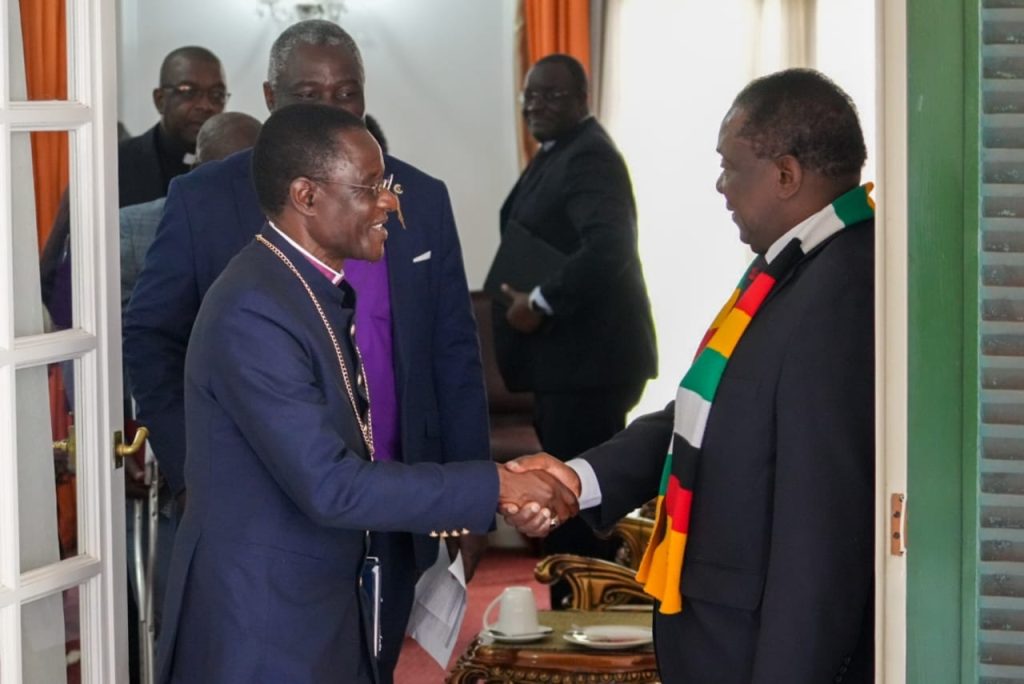
Harare, Zimbabwe – The Zimbabwe Heads of Christian Denominations (ZHOCD) today underscored their unwavering commitment to national development during a significant courtesy call on President Emmerson Mnangagwa at State House. The high-level engagement focused on the pivotal role of faith-based organizations in fostering a spiritually grounded and prosperous Zimbabwe.
Following the productive discussions, Bishop Ignatius Makumbe, the Anglican Bishop in Zimbabwe and President of the Zimbabwe Council of Churches (ZCC), characterized the visit as profoundly pastoral. “Our visit is solely pastoral,” Bishop Makumbe affirmed, emphasizing the delegation’s purpose: “We are simply coming to pray with the President for wisdom and for prosperity in our nation, Zimbabwe.”
The ZHOCD, a robust ecumenical coalition comprising the Zimbabwe Council of Churches (ZCC), the Zimbabwe Catholic Bishops’ Conference (ZCBC), the Evangelical Fellowship of Zimbabwe (EFZ), and the Union for the Development of Apostolic Churches in Zimbabwe Africa (UDACIZA), collectively highlighted the indispensable link between spiritual well-being and national progress. They articulated a vision where peaceful and spiritually rooted citizens are the bedrock of the country’s advancement.
The church leaders seized the opportunity to reassure President Mnangagwa of the Church’s continuous intercessions for peace, unity, and prosperity across the nation. They unequivocally reaffirmed their integral role in upholding moral values and strengthening social cohesion within Zimbabwean society.
This crucial meeting served to reinforce the enduring and collaborative relationship between the Government and faith-based organizations, a partnership consistently dedicated to driving national development and promoting an environment of peace and unity among all citizens. Churches in Zimbabwe are recognized as vital partners, actively contributing to socio-economic progress through their extensive work in education, health, and infrastructure development.
Through initiatives such as the construction of schools and clinics, the enhancement of community resilience, and tireless advocacy for peace, social cohesion, and women’s empowerment—particularly in rural areas—churches demonstrably complement and amplify government efforts, building a stronger, more unified Zimbabwe.