

LAW enforcement agencies are increasingly using digital forensic evidence and international databases to identify and rescue children appearing in sexual abuse images and videos circulating online.
Unlike conventional investigations, where police normally begin at a known crime scene and search for evidence, online child sexual abuse cases frequently start with an image or video whose victim, offender and place of origin are unknown.
Investigators must then work backwards, analysing seemingly minor details to establish where the abuse occurred, identify the child and arrest those responsible.
The material may be uncovered during child-exploitation investigations, proactive monitoring of online platforms or forensic examinations of seized mobile phones, computers and digital-storage devices.
Once discovered, it is treated not simply as harmful online content but as evidence of a serious crime and a possible indication that a child remains in danger.
Images become a digital crime scene
Specialist investigators study visual, audio and technical clues contained in images and videos.
These may include language, accents, clothing, furniture, electrical fittings, product packaging, school uniforms, buildings, weather conditions or distinctive objects appearing in the background.
Metadata and information recovered from seized devices may provide further leads, although offenders sometimes remove or manipulate identifying data.
A wallpaper pattern, bed linen, local product or voice heard in the background could help investigators narrow the material down to a particular country or region.
The objective is not merely to identify where the content was uploaded. Investigators must establish where the abuse took place, locate the child and determine whether the offender still has access to the victim.
Contrary to the widespread perception that the greatest danger comes from strangers, sexual abuse is frequently committed by somebody known to the child, including a relative, neighbour, family acquaintance or childcare professional.
This makes detection particularly difficult because much of the abuse occurs in private places and may remain hidden unless the victim discloses it or recorded material is discovered.
Global database connecting investigations
One of the principal tools used by investigators is the International Criminal Police Organisation’s International Child Sexual Exploitation database.
The secure database allows authorised specialists to compare material from different investigations and determine whether a victim, offender or location has previously appeared in another case.
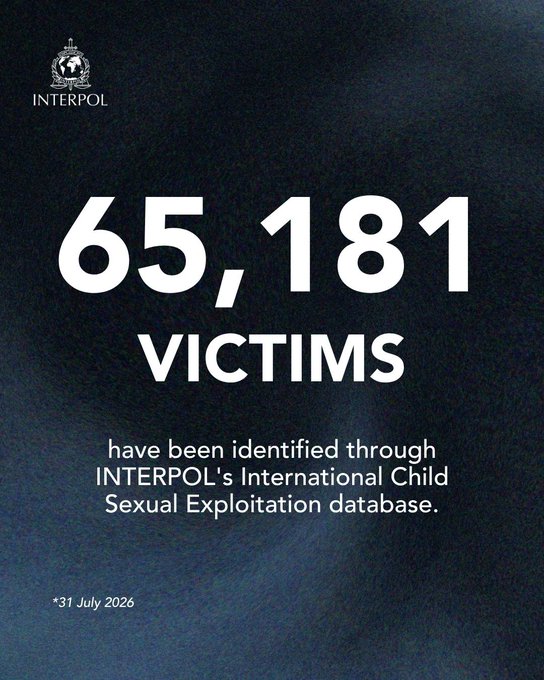
It currently holds approximately 4.9 million images and videos and has assisted authorities in identifying about 42,300 victims worldwide. Specialists from more than 70 countries can use the system to exchange information and coordinate investigations, according to INTERPOL.
More recent INTERPOL reporting indicates that the broader identification network had identified more than 56,000 victims and 24,000 suspected offenders by September 2025, with an average of 14 victims being identified daily.
The varying totals reflect different reporting periods and the continuing addition of cases to international investigative systems.
Image-comparison technology also prevents investigators in different countries from repeatedly analysing material that has already been classified. This allows specialists to concentrate on unidentified victims and previously unseen content.
It can also connect fragments of separate investigations. An image seized in one country may contain a clue recognised by investigators in another, while material uploaded through a server in one jurisdiction may depict abuse committed elsewhere.
Distribution causes continuing harm
Recorded abuse creates an enduring threat because the material can be copied, traded and redistributed long after the original crime occurred.
Every new circulation may expose survivors to renewed fear, humiliation and trauma. Removing a particular post or closing one account does not guarantee that other copies have disappeared.
INTERPOL has warned that repeated sharing of abuse material can re-victimise survivors and obstruct their long-term recovery.
For this reason, authorities distinguish between content removal and victim identification. Removing material from public view is important, but the child depicted may still be living with or regularly encountering the offender.
Investigators must therefore preserve the evidential value of seized material while preventing unnecessary viewing or further distribution.

Members of the public should never download, save, forward or repost suspected child sexual abuse material, even when attempting to expose the crime. Doing so can further circulate illegal content, harm the victim and potentially compromise an investigation.
Reports should instead include the account name, platform, web address and other non-graphic identifying information, where this can be recorded safely, before being submitted to police or an authorised reporting channel.
Specialist capacity remains uneven
Victim identification is demanding work requiring trained police officers, digital forensic experts, intelligence analysts, child-protection professionals and international cooperation.
Investigators may have to examine large volumes of distressing material while following strict rules governing evidence, confidentiality and the protection of victims’ identities.
The work also carries psychological risks for officers and analysts who are repeatedly exposed to traumatic content. Agencies consequently require staff-support systems, controlled access and procedures limiting unnecessary exposure.
INTERPOL has repeatedly called for countries to establish specialised child-exploitation units. It warned that some states still lack dedicated teams, adequate legislation or direct access to international investigative systems.
This creates gaps that offenders can exploit, particularly when material is produced, stored and distributed across several jurisdictions.
African participation in global investigative networks is therefore critical. Kenya became the first African country directly connected to the international database in 2019. Kenyan specialists subsequently contributed regional knowledge, including identifying African languages heard in material submitted by foreign agencies.
Coordinated operations producing results
Complex cases sometimes require investigators from several countries to examine unresolved material together through INTERPOL’s Victim Identification Task Force.
These exercises bring specialists into one operational setting to compare information, review cold cases and act on clues that individual agencies may have overlooked.
A year-long INTERPOL-coordinated operation across nine countries in the Americas recently led to the identification and rescue of 65 children and the arrest of 60 people suspected of sexual offences.
Most of the identified victims were aged between five and 13, while approximately 80 percent were girls, according to an INTERPOL statement released in March 2026.
The operation demonstrated that old material can still generate actionable leads when it is re-examined using improved technology and combined international expertise.
Technology expanding the threat
The scale of the challenge is also increasing as offenders use encrypted communications, livestreaming, anonymous accounts and cross-border payment systems.
Children may be groomed or coerced into producing images themselves, sometimes through threats, deception, promises of money or emotional manipulation. Offenders may then use the material to demand further images, sexual acts or payments—a form of abuse commonly described as sexual extortion or sextortion.
Artificial intelligence has added another dimension by enabling offenders to manipulate ordinary photographs or create synthetic sexual images depicting children.
WeProtect Global Alliance reported a 1,325 percent rise in reports linked to AI-generated child sexual abuse material submitted to the United States-based National Center for Missing and Exploited Children between 2023 and 2024.
The alliance warned that existing safeguards were failing to keep pace with the rapidly changing threat, despite improvements in content detection and legislation. Its findings are contained in the Global Threat Assessment 2025.
Artificial intelligence may, however, also assist investigators by grouping duplicate files, improving image comparisons and helping specialists process large volumes of evidence. INTERPOL is developing a new generation of its database incorporating enhanced facial, audio, video and text-analysis capabilities.
Human verification remains essential because automated systems can make mistakes, while any investigative use of facial recognition must be subject to privacy, evidential and child-protection safeguards.
Silence leaves victims exposed
Underreporting remains one of the largest obstacles. Children may remain silent because they fear punishment, stigma, disbelief or retaliation from an offender.
Some may not recognise grooming as abuse, while others do not know where to seek assistance. Victim-blaming can discourage children from reporting and protect perpetrators from scrutiny.
Research conducted under the UNICEF, INTERPOL and ECPAT International Disrupting Harm programme found significant reporting and awareness gaps across countries in Africa and other regions.
UNICEF says effective responses require child-friendly reporting systems, trained investigators, stronger protection services, digital-safety education and cooperation among governments, technology companies, schools, caregivers and civil-society organisations.
The central principle is that responsibility rests entirely with the offender. A child who was deceived, coerced or threatened into producing or sharing an image remains a victim of abuse and must receive protection rather than blame.
For investigators, every recovered image represents more than illegal content. It may be the first available clue leading police to an unidentified child, a hidden crime scene and an offender who has not yet been brought to justice.