
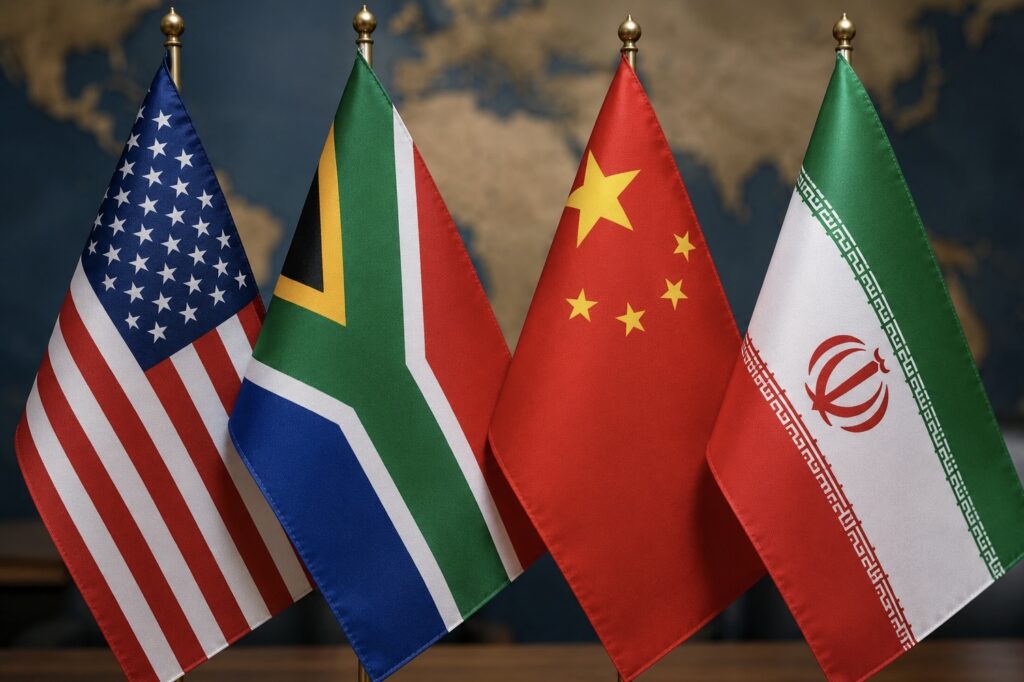
A fresh diplomatic storm has erupted between South Africa and the United States after US ambassador Leo Brent Bozell III publicly accused Pretoria of abandoning its policy of non-alignment by strengthening ties with China and hosting senior Iranian officials.
In a sharply worded social media post under the hashtag #NotSoNonAligned, Bozell questioned South Africa’s foreign policy stance, saying the government was choosing sides despite its repeated claims of neutrality.
“The government of South Africa rolls out the red carpet for Iran’s deputy foreign minister, while Deputy President Paul Mashatile is in Beijing deepening ties with China,” Bozell wrote.
He added:
“The South African people deserve an honest conversation about who their government is choosing to stand with.”
His remarks have reignited tensions between Washington and Pretoria at a time when relations between the two countries are already at their lowest point in decades.
Pretoria Fires Back
South Africa’s Department of International Relations and Cooperation (DIRCO) responded forcefully, insisting that the country remains firmly committed to an independent foreign policy.
ALSO READ: Zimbabwean Journalists Among International Participants at China’s AI Media Training Seminar
“As a sovereign nation, South Africa pursues an independent foreign policy firmly anchored in the principle of non-alignment,” the department said.
DIRCO stressed that non-alignment should not be confused with neutrality.
“We refuse to be drawn into geopolitical contestations or be pressured to take sides; instead, we prioritise inclusive dialogue, global peace, and our own national interests.”
The department also turned the criticism back on Washington, noting that the United States itself continues diplomatic engagements with both China and Iran.
China Joins the Debate
China’s ambassador to South Africa, Wu Peng, also weighed in, delivering a diplomatic rebuke to his American counterpart.
“Out of respect and diplomatic protocol, we don’t make comments on South Africa’s relations with other countries,” Wu said.
He added:
“Likewise, we oppose envoys of other countries publicly commenting on relations between China and South Africa.”
The comments underline the growing sensitivity surrounding South Africa’s expanding economic and political partnership with Beijing.
A Troubled Tenure
Bozell’s latest criticism is not his first clash with South African authorities.
Earlier this year, he came under fire after publicly dismissing South African court rulings regarding the controversial liberation song “Kill the Boer, Kill the Farmer.” His remarks prompted DIRCO to summon him for a formal diplomatic démarche.
Parliamentarians accused him of disrespecting South Africa’s judicial system, while opposition parties called for him to be declared persona non grata.
President Cyril Ramaphosa later reminded diplomats accredited to South Africa that disagreements should be addressed through “quiet, constructive diplomacy” rather than public confrontation.
South Africa Stands Firm
International Relations Minister Ronald Lamola has consistently defended Pretoria’s approach.
“South Africa does not take sides with any one country,” Lamola said.
He described non-alignment as:
“The ability to engage all international partners and take positions on a case-by-case basis, guided by our human rights outlook and international law.”
Deputy President Paul Mashatile’s visit to Beijing this week reinforced that position, with South Africa and China reaffirming their strategic partnership and discussing trade, infrastructure and investment cooperation.
At the same time, Iran’s Deputy Foreign Minister Saeed Khatibzadeh visited Pretoria, further fueling Washington’s concerns about South Africa’s international alliances.
Relations at Breaking Point
Relations between Pretoria and Washington have steadily deteriorated since Donald Trump returned to the White House. Diplomatic tensions have included trade disputes, aid suspensions, disagreements over land reform and black economic empowerment policies, as well as South Africa’s genocide case against Israel at the International Court of Justice.
South Africa has been without an ambassador in Washington since Ebrahim Rasool’s expulsion in March 2025, although veteran politician Roelf Meyer has since been deployed to help rebuild ties.
For many observers, the latest war of words raises a larger question: Can South Africa maintain its policy of non-alignment in an increasingly divided world?
As global powers compete for influence, Pretoria insists it will continue engaging East and West alike.
But Ambassador Bozell’s criticism suggests Washington is no longer willing to accept South Africa’s balancing act without challenge.
“Non-alignment is not neutrality,” Pretoria insists.
“You have chosen,” Washington replies.
And between those competing narratives lies one of South Africa’s biggest diplomatic tests in the modern era.