
Business
RBZ Cracks Down on Shadow Lending by Mobile Operators


HARARE—The Reserve Bank of Zimbabwe (RBZ) has directed mobile network operators to regularise mobile money operations by June 2026, ordering the removal of unverified accounts and mandating that all nano-loans be backed by commercial banks.
Announcing the measures while presenting the 2026 Monetary Policy Statement, RBZ Governor John Mushayavanhu said compliance inspections will be carried out at the end of June to ensure full adherence to the new framework.
Under the directive, mobile network operators must work with the Registrar-General’s Office to verify all mobile money accounts using valid national identity documents. Accounts that fail verification will be shut down. The central bank says the exercise is intended to block the use of anonymous wallets for money laundering and other illicit financial activities.
Governor Mushayavanhu said the continued existence of unverified accounts poses a serious risk to financial integrity, stressing that operators must begin cleansing their customer databases without delay.
Zero-fee transactions extended to mobile platforms
In a further move, the RBZ has extended the zero-charge policy for low-value transactions—ranging from US$0 to US$5—to mobile money platforms. The concession had previously applied only to banks.
The Governor warned that any operator found levying fees on transactions within this threshold could face the withdrawal of its payment services licence.
Mobile nano-loans to be fully regulated
The central bank also moved to rein in instant micro-loans offered through mobile applications, arguing that such products have effectively created money outside the formal banking system.
Going forward, all nano-loans must be underwritten by licensed commercial banks and recorded on their balance sheets. The RBZ will conduct audits to ensure these lending activities comply with banking regulations and prudential standards.
The new rules represent a major tightening of oversight over mobile network operators, whose expansion into financial services has increasingly blurred the line between telecoms and banking.
According to the RBZ, the reforms are designed to close regulatory gaps, curb arbitrage, and ensure that all entities involved in financial intermediation operate within a properly supervised framework.

By Everisto Zhuwao
The Environmental Management Agency (EMA) on Thursday launched a major initiative to combat mercury pollution during an inception workshop held at the Holiday Inn Harare. The project specifically targets the mitigation of mercury emissions and releases from coal combustion power plants across Zimbabwe.
The workshop brought together a diverse group of experts and government officials to coordinate a national response to toxic emissions. Mr. A. Matiza, the Deputy Director for Environment in the Ministry of Environment, Climate and Wildlife, officially opened the session. In his remarks, he stressed that collaborative efforts are essential to safeguard both the environment and public health from the dangers of mercury pollution.
Mercury is a significant concern in energy production because it is released into the atmosphere when coal is burned to generate electricity.
The project falls under the Minamata Convention on Mercury, an international treaty designed to protect people and the environment from the harmful effects of mercury.
By focusing on power plants, the government aims to introduce cleaner technologies that reduce these hazardous emissions while maintaining efficient energy production.
Several key organisations participated in the roadmap development, including the Zimbabwe Power Company, Hwange Colliery Company, and the Ministry of Health and Child Care.
Legal and regulatory bodies such as the Zimbabwe Environmental Law Organization and the Procurement Regulatory Authority of Zimbabwe were also present to ensure the project aligns with national laws and international standards.
The initiative seeks to reform existing environmental policies and build technical capacity within local communities and regulatory institutions. By fostering partnerships between government and industry, the project aims to ensure that Zimbabwe’s energy future is both sustainable and responsible.
This collective commitment lays the foundation for a cleaner environment and a healthier future for all citizens.

Everisto Zhuwao
Agriculture remains the cornerstone of Zimbabwe’s journey toward national prosperity. The Deputy Minister of Lands, Agriculture, Fisheries, Water and Rural Development, Vangelis Peter Haritatos, reaffirmed this vision during a recent field day hosted by Charter Seeds.
The event served as a platform for the government to outline its ambitious roadmap for the sector.
The Deputy Minister highlighted the government’s commitment to the Agriculture and Food Systems Rural Transformation Strategy 2, an initiative aimed at growing the agricultural sector into a US$15.8 billion industry by 2030.
According to Hon. Haritatos, the ultimate goal is to transition the nation from basic food security to true food sovereignty. This shift will ensure that Zimbabwe maintains full control over its food systems, from seed production to the final market sale.
To achieve these targets, the government is actively investing in critical infrastructure such as irrigation systems and modern mechanisation. These efforts are being complemented by the establishment of village business units designed to empower local farmers.
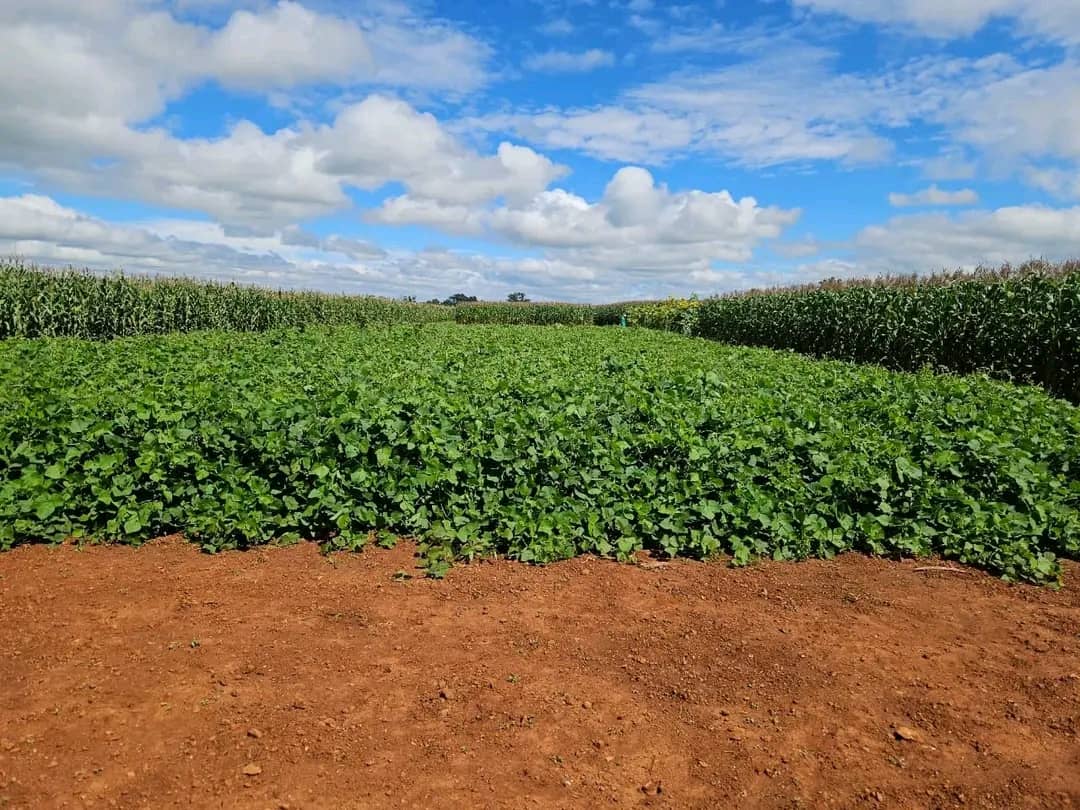
Hon. Haritatos urged producers to view themselves as businesspeople and custodians of the land. He emphasized that adopting innovative, market-driven practices is no longer optional but a necessity for growth.
Sustainability and data-driven decision-making were central themes of the address. The Deputy Minister reminded the audience that the quality of today’s seeds determines the success of tomorrow’s harvest.
He encouraged farmers to become lifelong students of their craft and to share their knowledge as ambassadors of the agricultural sector.
By focusing on quality seed genetics and efficient resource management, the government believes that agriculture will serve as the primary engine for Zimbabwe’s economic transformation.

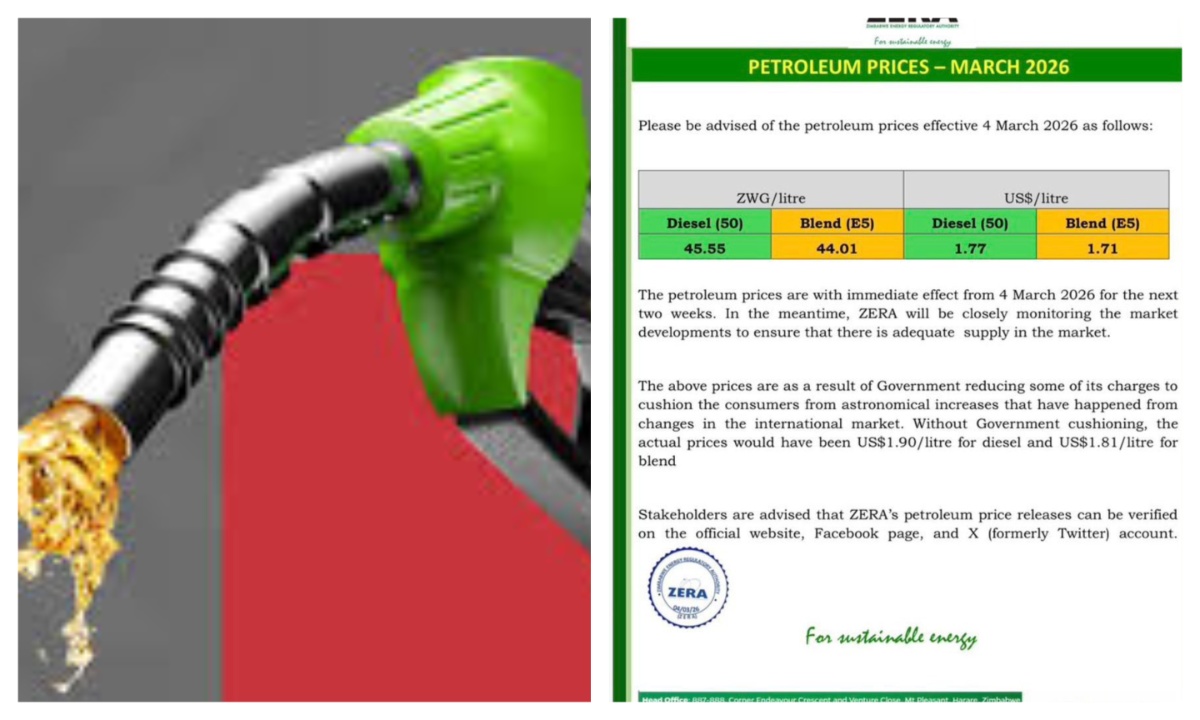
Fuel prices in Zimbabwe have increased following the Zimbabwe Energy Regulatory Authority (ZERA) ‘s announcement of new petroleum prices, which took effect on March 4, 2026.
In a notice released by the energy regulator, diesel is now priced at US$1.77 per litre, while petrol blend (E5) is selling at US$1.71 per litre.
In local currency, diesel is pegged at ZWG 45.55 per litre and petrol blend at ZWG 44.01 per litre.
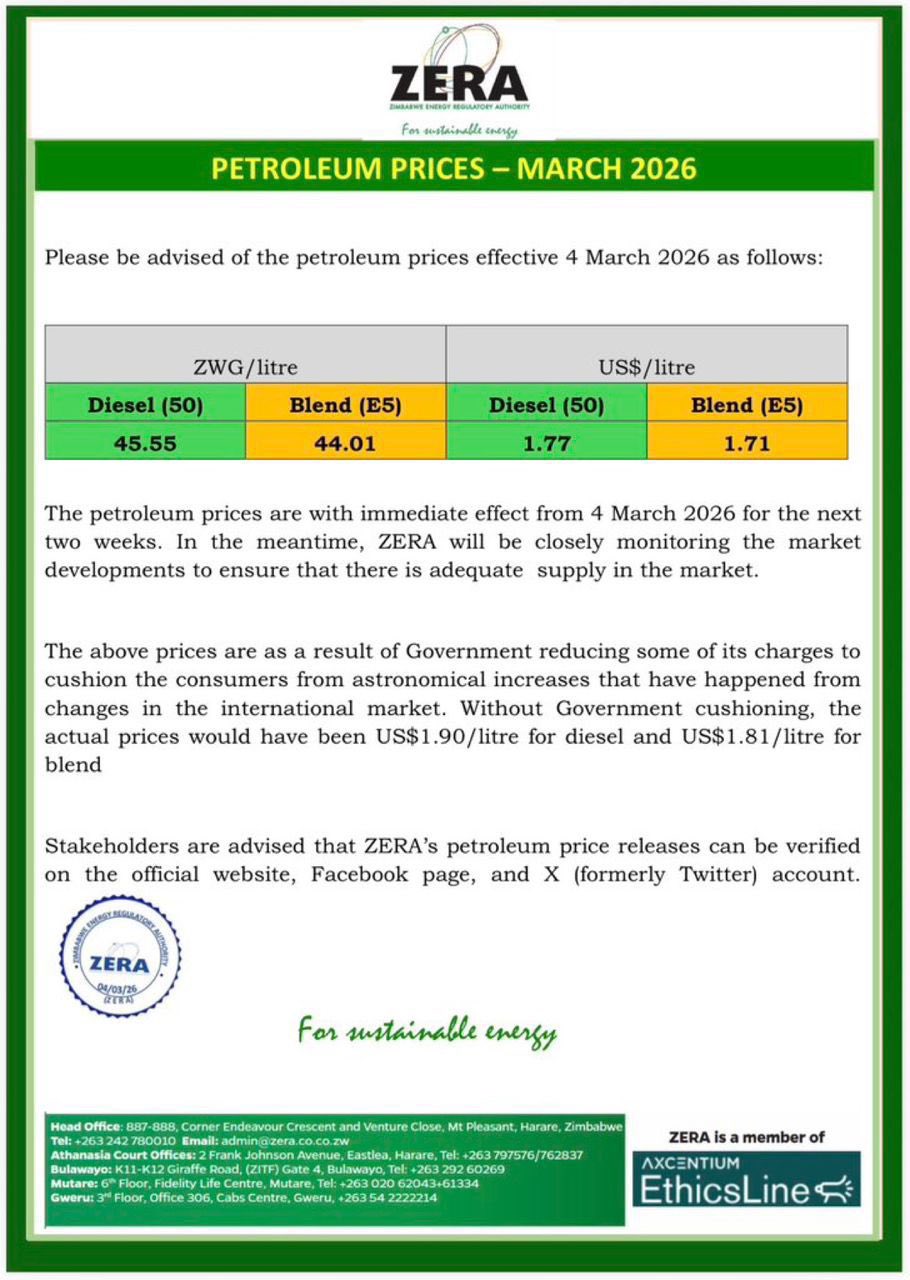
The regulator said the new prices will remain in effect for the next two weeks, while authorities continue to monitor developments in the global fuel market.
ZERA indicated that the latest fuel prices were influenced by changes in international petroleum markets, which have pushed prices upward.
However, the Government reduced some of its charges to cushion consumers from sharper increases.
“The above prices are as a result of the government reducing some of its charges to cushion the consumers from astronomical increases that have happened from changes in the international market,” the regulator said in the statement.
According to ZERA, without the Government’s intervention, the price of diesel would have reached US$1.90 per litre, while petrol blend would have been US$1.81 per litre.
The regulator added that it will continue to closely monitor market developments to ensure there is an adequate fuel supply in the country.
Stakeholders were also advised that official petroleum price updates can be verified through ZERA’s official communication platforms, including its website and social media pages.
Zimbabwe reviews fuel prices regularly, largely in line with international oil price movements and exchange rate developments.
The adjustments often have a ripple effect across the economy, influencing transport costs, food prices, and other goods and services.

Dynamos, Highlanders Play Out Thrilling Draw in Season’s First Battle of Zimbabwe

Ngezi Platinum Stars Hold Defending Champions Scottland at Rufaro

Garwe to Commission Fire Tender, Equipment for Insiza, Umzingwane

Operation restore order

Masasi High School Abuse Scandal Sparks Public Outcry

Kuwadzana Man Jailed for Reckless Driving and Driving Without a Licence
-
 Current Affairs4 months ago
Operation restore order
-
 Crime and Courts6 months ago
Masasi High School Abuse Scandal Sparks Public Outcry
-
 Crime and Courts6 months ago
Kuwadzana Man Jailed for Reckless Driving and Driving Without a Licence
-
 Current Affairs8 months ago
Breaking: ZIMSEC June 2025 Exam Results Now Available Online
-

 Current Affairs7 months ago
Munhumutapa Day: Zimbabwe’s Newest Public Holiday Set for Annual Observance
-

 Current Affairs5 months ago
BREAKING NEWS: ZANU PF Director General Ezekiel Zabanyana Fired
-

 Current Affairs7 months ago
No Racism in Our Cricket: Government
-

 World News5 months ago
Burkina Faso Reaps $18 Billion in Gold Revenue Under Ibrahim Traoré’s Leadership