
Current Affairs
Delivering Miracles at Dawn: Inside Epworth’s Home Birth Stories

By Kudakwashe Emma-Louise Zihonye
Melody heard a knock on her door around 4 am in the early hours of Mothers’ Day. The cold mornings of the month of May makes it hard to wake up, but for her it was not much of a surprise as she is used to these unannounced emergencies. On the door was Christa’s husband who came in to seek help as Christa had been in labour the whole night. She grabbed a pair of gloves and followed the young man.
69-year-old Melody rushed to the homestead with her crutch supporting her fragile body on the rocky landscape. Christa gave birth to a baby boy in a dark room with no light around 6:05 am on the 11th of May 2025.
To Melody, this is not a rare occurrence as she has been doing this in the dormitory suburb of Epworth for more than 20 years.
“This has been my life since 2003 as a Traditional Birth Attendant here in Epworth. I offer delivery services for those in need, but receive no money or compensation for this work. However, for me and the rest of the 25 women I work with, we realise that people are in need of such services,” said Melody Nyakudanga.

A young mother carries her baby on her back after visiting Gogo Nyakudanga in Epworth. More
than just a traditional midwife, Gogo serves as a trusted counsellor in the community. Photocredit- Kudakwashe Emma-Louise Zihonye
The Traditional Midwives group which is registered with the Traditional Medicines Council of Zimbabwe, has managed to deliver 710 babies since 2021 according to their records.
“We have helped deliver over 710 babies in Epworth only over the past 4 years not because we want to, but because most of these girls cannot afford to give birth at our local clinic. They do not have resources, and we cannot let them do it on their own,” she said.
Epworth, is densely populated suburb 12 kilometers southeast of Harare, with a few clinics. The nearest one is Dombo Clinic which now serves as vital healthcare lifeline, providing basic medical care to thousands of residents who have limited access to health facilities.

Gogo Nyakudanga
The community faces persistent challenges like poor sanitation, with many households lacking access to proper waste management systems, and limited and unreliable water supply. Overcrowding, a legacy of years of unplanned settlement, puts immense pressure on the available infrastructure and services. Some parts of Epworth do not have electricity.
Some young women in Epworth now prefer giving birth at home with traditional birth attendants rather than going to the local clinics because of the risks and expectations at these clinics.

An expecting young mother holds her baby close to one of the Mbuya Nyamukuta’s homes. Her pregnancy was not registered at a local clinic because she could not afford the $40 required, and she is likely to give birth at home. Photo Cred – Kudakwashe Emma-Louise Zihonye
Nyarai, (not her real name) said that it is not safe to deliver at local clinics as negligence and corruption is now the norm.
“Without money and required medical supplies, the nurses at Dombo Clinic will not even look at you. They will even let you give birth at the gate if you are not registered, or if you do not have money. It is really dangerous for expecting mothers. Traditional midwives welcome us with open arms. Even if we have not had something to eat from our homes, they will prepare food for us regardless of their own circumstances”, she added.
Dombo Clinic in Epworth charges nearly $40 USD to register pregnancy and requires one to purchase some of the utensils used during birth. Additionally, on the delivery date, an expecting mother has to bring an additional $40 USD for emergency ambulance services to a bigger hospital in case of complications arising. The cost of services prevents many women from seeking necessary clinical midwifery support, leaving them vulnerable during pregnancy and childbirth.

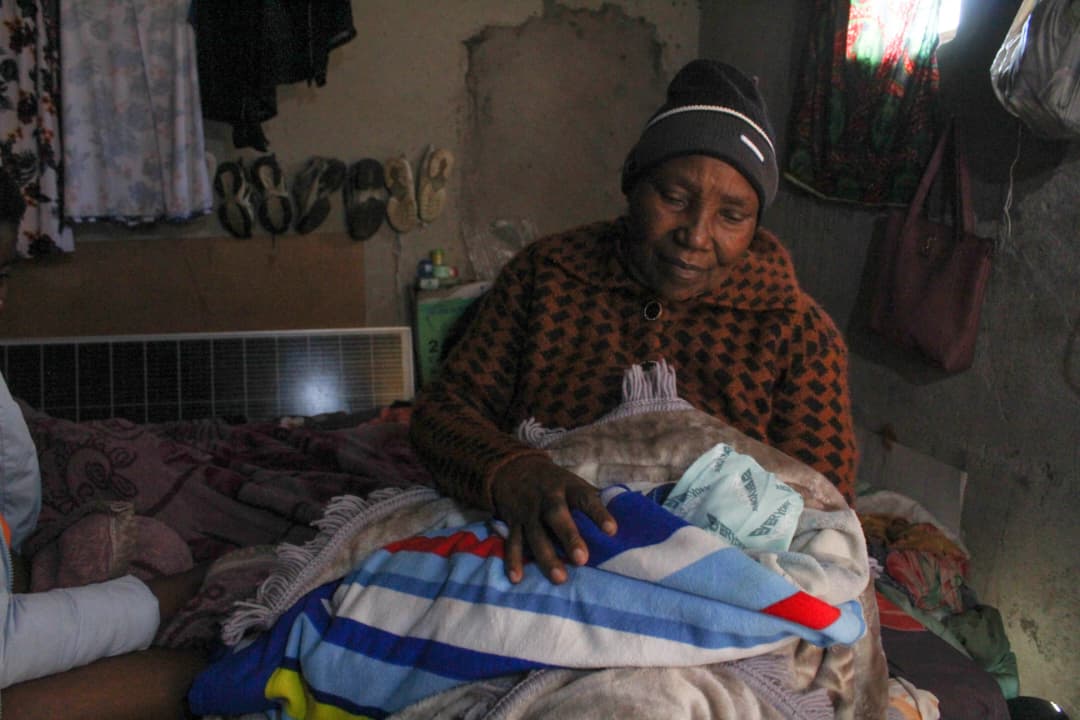
Gogo Nyakudanga holds a newborn baby she had just delivered early morning on 11 May 2025. Photocredit – Kudakwashe Emma-Louise Zihonye
Maternal health should be a right accessible to all, yet many women find themselves unable to afford the rising costs associated with childbirth in public hospitals. In their search for care, many turn to traditional midwives, who, despite limited resources, provide critical support and care to under-served communities.
Zimbabwe has one of the highest maternal mortality rates in the world. According to the latest Zimbabwe Demographic and Health Survey 2024, 212 mothers die for every 100,000 live births, and 14% of all births are home deliveries.
Neonatal deaths has increased from 29 per 1000 to 37 per 1000 live births, meaning many babies die within the first 28 days of life.

Epworth clinic. Photocredit- Kudakwashe Emma-Louise Zihonye
“We are trained and certified by the Traditional Medicines Council of Zimbabwe. However, it has been long since we had training, and we wish that we could get free courses where we could upgrade our knowledge for the betterment of the Epworth community,” said Melody.
According to the World Health Organisation, millions of women globally still give birth without a skilled health worker by their side, and one-third do not receive even four of WHO’s recommended eight pregnancy checks.
Anna Sande, former Mayor of Epworth, said most of the local clinics are out of reach for many in terms of the charges, considering the harsh economic realities in our country.

Gogo Nyakudanga stands at her door, where she usually receives knocks for birth emergencies. Photocredit- Kudakwashe Emma-Louise Zihonye
“Affordability is a real issue. Traditional Midwives are, basically, an alternative. Hospitals turn away women for not having the materials needed for a delivery, and may even require you to purchase your own utensils such as cotton, blades and other things. What I think, is that the local authority should prioritise care for mothers before finance because access to health care is a human right, and it should not be compromised.”
Basic needs for mothers should be readily available in clinics so that women are not be turned away. Epworth deserves to be a society with healthy mothers and healthy babies,” Sande added.
Zimbabwe’s healthcare system faces chronic challenges, including an exodus of health workers to other countries in search of better working conditions, competitive salaries, and improved career prospects. This brain drain has left public hospitals and clinics severely understaffed, leading to longer waiting times, poor patient-to-doctor ratios, and overstretched facilities. Essential services such as maternal care, emergency response, and specialised treatments are compromised, further weakening the system’s ability to provide quality healthcare.
Itai Rusike, the Executive Director at Community Working Group on Health (CWGH), said that poor quality care remains a key issue for maternal and child health services in the public health institutions during the absence of nurses and doctors as a result of the ill capacitation crisis and the prolonged impasse.
“There is need to increase focus on quality of care in the provision of maternal and child health services. Home deliveries are a key factor in the county’s high maternal mortality.”
” Traditional Birth Attendants are now the norm in many urban poor communities due to the non-functionality of the public health institutions as a result of the incapacitation. However, TBAs are not properly skilled to deal with complications that may arise during a delivery and they are also not equipped to provide post-natal care services to the newborns,” he emphasised.
The United Nations Population Fund emphasises that maternal health services are part of reproductive rights. Access to services (antenatal, delivery, postnatal), information, family planning, are all part of what “sexual and reproductive health” means.
ALSO READ : Auditor General Flags Misuse of Funds at Epworth Local Board
Source – TheZimbabweTimes


The Ministry of Health and Child Care has launched an aggressive two-round polio vaccination campaign to “interrupt the transmission of polioviruses” across 20 high-risk districts, mobilising door-to-door teams to reach every child under five.
Round one runs 20–23 April 2026, with a second round scheduled for 2–5 June 2026.
The drive is part of a “coordinated regional effort alongside Botswana, Malawi, Mozambique and Zambia”.
Targeted districts include Bulawayo’s Emakandeni, Northern Suburbs and Nkulumane; Harare City, Chitungwiza, Epworth and Ruwa, as well as Mutare, Chimanimani, Chipinge, Mbire, Mudzi, Kariba, Chiredzi, Binga, Hwange, Bulilima, Matobo and Gwanda.
“All children under five years of age in these districts must be vaccinated, regardless of their previous vaccination status,” the ministry said.
Vaccination teams are using “door-to-door outreach, fixed sites, and mobile units to ensure every child is reached”.
Health authorities urge parents to cooperate fully. No polio case has been announced, but the pre-emptive strike follows regional detection of circulating vaccine-derived polioviruses.


The ZANU PF Youth League has strongly opposed a reported plan by businessman Mr Wicknell Chivayo to donate US$3.6 million to the Parliament of Zimbabwe.
In a press statement issued by the Deputy Secretary for Youth Affairs, Cde Hon. John Paradza, the League described the proposed gift as “misguided” and a threat to the independence of the legislature.
The reaction follows social media reports alleging that the businessman intends to fund the august House.
While the Youth League acknowledged Mr Chivayo’s right to engage in philanthropy, they warned that State institutions must not operate on handouts.
“Parliament is the backbone of democracy,” the statement read. “It cannot be seen as being bought or swayed through donations, whether in cash or kind, that appear transactional.”
The League argued that the Government has adequate capacity to support its own programmes.
They pointed to existing mechanisms such as the Constituency Development Fund (CDF) and the Devolution Fund as evidence of the State’s ability to drive national development without private interference.
The Youth League further suggested that if the businessman wishes to help, he should focus on direct community initiatives.
They expressed concern that such a massive donation to a branch of Government could be perceived as an attempt to influence the Executive, Judiciary, or Parliament.
“We call upon Members of Parliament to take a stand against any attempt to bring the Parliament of Zimbabwe into disrepute,” Cde Paradza added.
Hemphasised that the nation’s progress is guided by the structured policies and fiscal discipline of President Emmerson Mnangagwa’s administration.
In its conclusion, the League urged Parliament to officially refuse the donation. They stated that they would not hesitate to reprimand anyone using tactics that bring the name of the President into disrepute.
The Youth League maintains that Zimbabwe’s path toward Vision 2030 must remain self-reliant and transparent.

The Minister of Health and Child Care, Douglas Mombeshora, has called on nurses in selected health institutions to suspend their ongoing industrial action, as government moves to stabilise the environment for renewed negotiations.
The appeal comes amid growing concern over the impact of the strike on healthcare delivery, with authorities pushing for what the Minister described as a transparent and constructive engagement process.
During a recent address, Dr Mombeshora acknowledged the concerns raised by nurses and reaffirmed government’s commitment to resolving the matter.
“The government fully acknowledges the grievances raised by the nursing fraternity and remains committed to finding a sustainable resolution,” he said.
The industrial action, which began on April 20, 2026, was triggered by long-standing challenges faced by healthcare workers, including poor working conditions, rising transport costs, and dissatisfaction with recent salary adjustments.
The Zimbabwe Nurses Association (ZINA) has expressed frustration over the salary review, indicating that the increment fell far below expectations and has left many nurses struggling to meet basic living expenses.
In response, government has convened an extraordinary technical meeting involving the Health Apex Panel and the Health Services Commission to urgently assess the situation and explore possible solutions.
While recognising the legitimacy of the nurses’ concerns, the Ministry has emphasised the need to strike a balance between improving worker welfare and maintaining essential healthcare services.
“Nurses must return to work to ensure that patients are not adversely affected while negotiations continue,” Minister Mombeshora stated.
The government maintains that dialogue remains the best path toward a lasting solution.
Union leaders had initially held off on industrial action to allow for legal processes and engagement with authorities.

Polio blitz: 20 districts targeted

Ngizwe Mchunu Sparks Outrage Over Alleged Assault and Remarks on Foreigners

ZANU PF Youth League Rejects Chivayo Donation

Operation restore order

Masasi High School Abuse Scandal Sparks Public Outcry

Kuwadzana Man Jailed for Reckless Driving and Driving Without a Licence
-
 Current Affairs5 months ago
Operation restore order
-
 Crime and Courts7 months ago
Masasi High School Abuse Scandal Sparks Public Outcry
-
 Crime and Courts7 months ago
Kuwadzana Man Jailed for Reckless Driving and Driving Without a Licence
-

 Current Affairs9 months ago
Breaking: ZIMSEC June 2025 Exam Results Now Available Online
-

 Current Affairs8 months ago
Munhumutapa Day: Zimbabwe’s Newest Public Holiday Set for Annual Observance
-

 Current Affairs6 months ago
BREAKING NEWS: ZANU PF Director General Ezekiel Zabanyana Fired
-

 Current Affairs8 months ago
No Racism in Our Cricket: Government
-

 World News6 months ago
Burkina Faso Reaps $18 Billion in Gold Revenue Under Ibrahim Traoré’s Leadership