
Current Affairs
Government Places Local Authorities’ Master Plans Under 90-Day Public Review

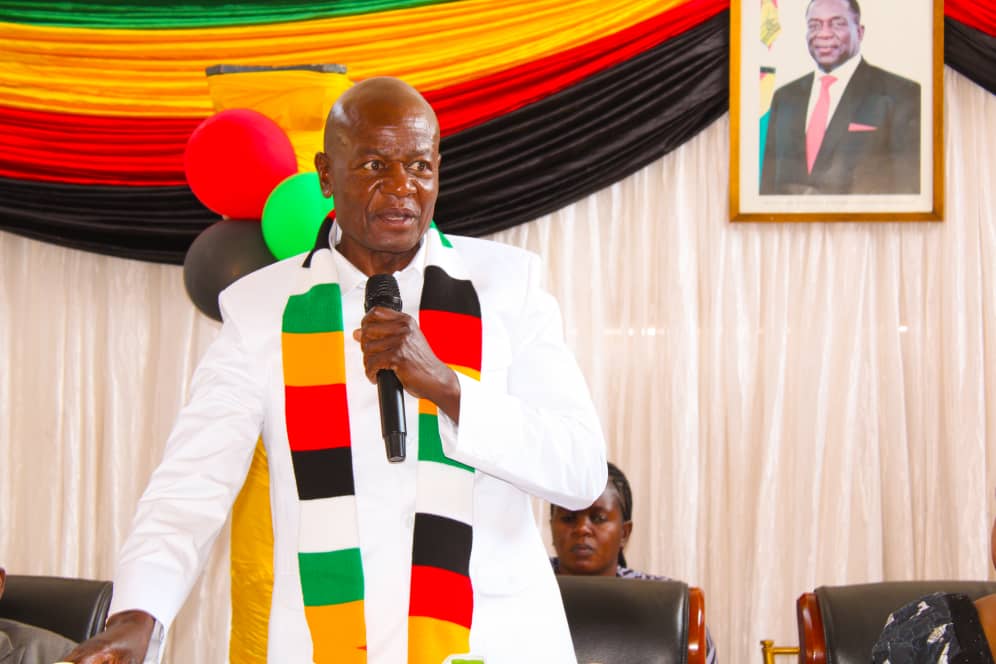
The Government has placed Master Plans from local authorities under a mandatory 90-day public review period before they can be implemented, Local Government and Public Works Minister Daniel Garwe has confirmed.
Speaking in Victoria Falls, Minister Garwe underscored the importance of the Master Plans, describing them as essential tools for structured development, strengthened provincial economies and the elimination of disorderly land use patterns.
Zimbabwe has 92 local authorities, and 91 have already submitted their Master Plans for assessment. Technical teams from the ministry have completed preliminary evaluations, while one urban authority is still to hand in its plan.
“We have 92 local authorities — 32 are urban and 60 are rural district councils. Of the 32 urban councils, only one has not finalised and submitted its Master Plan,” Minister Garwe said.
He noted that although he would not disclose the identity of the outstanding council, the ministry is ready to share details with stakeholders who visit the offices. All submitted plans, he added, have undergone initial appraisal and are now open for public examination.
“We have completed the assessment stage, and the plans are now under public scrutiny. The next 90 days will allow the public to review them, after which implementation will begin.”
Minister Garwe commended the councils for meeting the requirements, saying the Master Plans are integral to achieving the country’s Vision 2030 targets.
Master Plans provide long-term direction on land use, infrastructure expansion, environmental protection and economic zoning. They serve as legally enforceable development blueprints designed to guide systematic growth across both urban and rural spaces.
For years, poor spatial planning, mushrooming illegal settlements and inadequate services have hampered development in many local authorities. The new Master Plans aim to address these challenges by offering clear, structured pathways for sustainable development.
Minister Garwe highlighted that the plans will play a central role in building strong provincial economies. By allocating land for industrial, agricultural, commercial and residential development, local authorities are expected to attract investment, boost entrepreneurship and create jobs aligned with each region’s economic potential.
“Sustainability is key,” he said. “We are planning not just for the present, but for future generations. These Master Plans will enable organised, environmentally conscious and resilient growth that enhances the quality of life for citizens.”
The 90-day review window provides residents, experts and other stakeholders with an opportunity to analyse and comment on the proposed plans. This consultative approach is meant to promote transparency and ensure that final documents reflect community priorities.
After the review period, Government will move to implementation — a step expected to significantly improve local governance and service delivery nationwide.
Planning experts and business leaders have welcomed the development, saying the move will help synchronise local authority planning with national objectives under the National Development Strategy (NDS1).








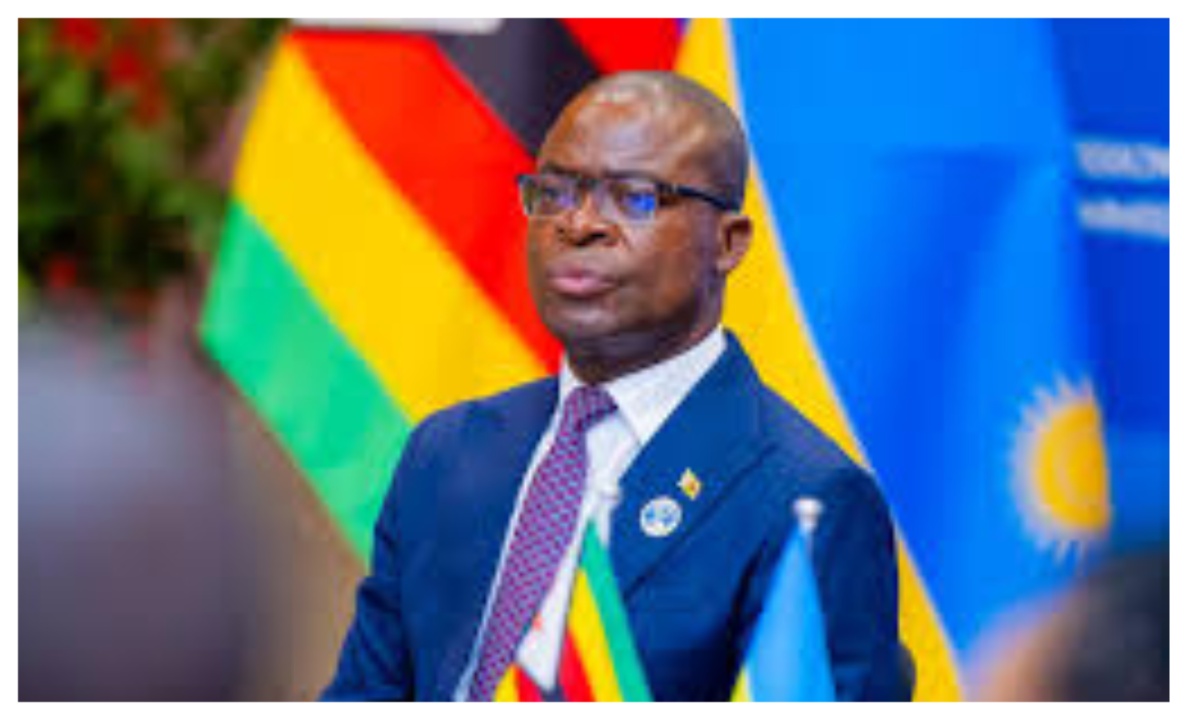
The Minister of Foreign Affairs and International Trade, Dr Amon Murwira, has assured Parliament that the Government of Zimbabwe will ensure its citizens in South Africa receive full access to health services, regardless of their circumstances.
Speaking during the National Assembly Questions and Answers Session in the Parliament of Zimbabwe on Wednesday, Dr. Murwira said the government is actively working through its diplomatic missions to safeguard the welfare of Zimbabweans abroad.
“We have our Consulate in South Africa, who are making sure that Zimbabweans in South Africa get health access, no matter what,” he said.
The Minister noted that reports alleging that Zimbabweans and other foreign nationals were being denied medical and health services in South Africa had not been formally communicated to the Government of Zimbabwe.
“This issue of denied medical and health services to Zimbabweans and other foreigners has not been fully communicated to us formally, but it is being discussed by people who want to push their agendas,” Dr Murwira told legislators.
He reaffirmed the government’s commitment to protecting citizens wherever they may be.
“No matter where the Zimbabwean is, be it in prison or everywhere, we make sure that they get full medical services,” he said.
The remarks come amid ongoing debate around access to healthcare services for migrants in South Africa and concerns raised over the treatment of foreign nationals within the region.
The Minister’s statement underscores Harare’s position that Zimbabwean diplomatic missions remain actively engaged in ensuring citizens’ rights and access to essential services abroad.

The Zimbabwe National Network of People Living with HIV (ZNNP+) has expressed concern over the possible impact of Zimbabwe’s decision to discontinue negotiations on a proposed US$350 million health funding agreement with the United States.
In a statement released on Monday, ZNNP+, which represents more than 1.3 million people living with HIV (PLHIV) in Zimbabwe, warned that the move could put lives at risk if alternative funding is not secured.
The organisation acknowledged the Government’s responsibility to protect national sovereignty but said international health partnerships have played a critical role in Zimbabwe’s HIV response for decades. Support from US-backed programmes such as PEPFAR and USAID has helped ensure access to antiretroviral therapy, viral load testing, and treatment for advanced HIV-related conditions.
ZNNP+ said suspending negotiations could create a major funding gap that the national budget may struggle to cover, potentially affecting the supply of life-saving medication and support services.
The group raised concerns about possible treatment interruptions, warning that any break in antiretroviral therapy could lead to drug resistance, opportunistic infections, and increased deaths. It also cautioned that Zimbabwe’s progress toward the global 95-95-95 HIV targets could be reversed.
ZNNP+ further noted that health funding supports more than medication, including community health workers, rural clinics, and support systems relied upon by vulnerable populations.
The organisation also warned that rejecting US government funding could weaken trust with other international partners, including the Global Fund, the United Nations, and the European Union.
ZNNP+ has appealed to the Government of Zimbabwe, through the Ministry of Health and Child Care and the Ministry of Foreign Affairs and International Trade, to re-engage in dialogue and put the lives of people living with HIV at the centre of negotiations.
The organisation also called on the government to provide a clear contingency plan outlining how the US$350 million funding gap would be covered if talks do not resume, to ensure that no person living with HIV is left without treatment or support.
ZNNP+ said it remains ready to work with all stakeholders to help develop an agreement that protects national interests while safeguarding public health.

Everisto Zhuwao
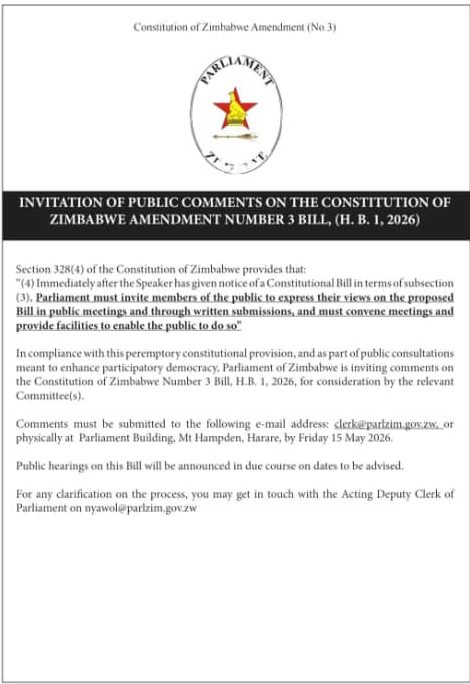
Members of the public are being invited to provide input on the proposed Constitution of Zimbabwe Amendment No. 3 Bill (H.B. 1, 2026).
Under Section 328(4) of the Constitution of Zimbabwe, once the Speaker gives notice of a Constitutional Bill, Parliament is required to solicit public views. This can be done through public meetings as well as written submissions. The law further mandates that Parliament convene meetings and provide facilities to ensure that the public can participate fully in the consultation process.
The invitation represents an opportunity for Zimbabweans to engage directly in shaping the country’s constitutional framework. Citizens are encouraged to study the proposed Bill and share their views, either by attending public forums or submitting their comments in writing.
Parliament will announce dates, venues, and procedures for the public consultations to ensure inclusive and transparent participation.
This initiative reinforces the constitutional principle that democratic governance is strengthened through active citizen engagement, providing Zimbabweans with a platform to voice opinions on legislation affecting the nation.

“No Matter Where They Are in SA” — Govt Vows Full Medical Support for Zimbabweans

DIABETES CURE… OR THE BEGINNING OF THE END FOR INSULIN DEPENDENCE?

HIV Network Raises Concern Over Halted US Health Funding Talks

Operation restore order

Masasi High School Abuse Scandal Sparks Public Outcry

Kuwadzana Man Jailed for Reckless Driving and Driving Without a Licence
-
 Current Affairs3 months ago
Operation restore order
-
 Crime and Courts5 months ago
Masasi High School Abuse Scandal Sparks Public Outcry
-
 Crime and Courts5 months ago
Kuwadzana Man Jailed for Reckless Driving and Driving Without a Licence
-
 Current Affairs7 months ago
Breaking: ZIMSEC June 2025 Exam Results Now Available Online
-
 Current Affairs6 months ago
Munhumutapa Day: Zimbabwe’s Newest Public Holiday Set for Annual Observance
-

 Current Affairs5 months ago
BREAKING NEWS: ZANU PF Director General Ezekiel Zabanyana Fired
-

 Current Affairs6 months ago
No Racism in Our Cricket: Government
-

 Current Affairs6 months ago
Government Bans Tinted Car Windows in Nationwide Crime Crackdown