
Current Affairs
ZEC says all set for Nkulumane parliamentary by-election


The Zimbabwe Electoral Commission (ZEC) has confirmed it is fully prepared to conduct the Nkulumane Constituency parliamentary by-election scheduled for this Saturday, saying all logistical, security and operational arrangements are now in place.
Addressing the media on Tuesday at Nkulumane High School, which has been designated the command centre, Constituency Elections Officer Mrs Sithembiso Khuphe said the electoral body had reached an advanced stage of preparedness, with personnel and materials already being deployed across the constituency.
The by-election was triggered by the death of Citizens’ Coalition for Change (CCC) legislator Desire Moyo in October.
Mrs Khuphe said the poll will be held across 34 polling stations and involves a total of 22 883 registered voters.
“All preparations for the by-election set for Saturday, December 20, are now at an advanced stage,” she said. “Election materials and staff deployment are already underway.”
She added that ZEC had completed training for all election officials, including ward elections officers, presiding officers and recorders who will man polling stations on election day.
Polling will take place at a variety of venues, including schools, halls, churches and tented facilities. Mrs Khuphe said 15 polling stations will operate from tents, which have already been erected.
“We have ensured that all polling centres are fully prepared, regardless of the type of infrastructure being used,” she said.
Mrs Khuphe confirmed that ballot papers and voters’ rolls were ready and that ballot papers were being collected from Windsor Park before being distributed to ward collation centres at Nkulumane High School and Queen Elizabeth Primary School.
On security, she said the Zimbabwe Republic Police would be present at all polling stations.
“Each polling station will be manned by two police officers, with additional deployment at tented stations to ensure safety and order,” she said.
Nine candidates are contesting the seat, including Zanu-PF’s Cde Freedom Murechu, Ethel Sibanda of MDC-T and Alson Moyo of EFF Zimbabwe. The CCC has fielded musician and radio personality Mothusi Ndlovu, popularly known as Madlela.
Other contenders include Zapu’s Vivian Siziba, ZANC candidate Nompilo Ncube Malala, and independents Rodney Donovan Jele, Mbuso Fuzwayo of Ibetshu LikaZulu, and Esther Auxillia Zitha, the widow of the late MP.
Mrs Khuphe said ZEC had engaged all political parties and candidates through its multi-party liaison committee.
“All contesting parties attended our liaison meeting on Monday. We are satisfied that all stakeholders have been adequately briefed,” she said.
She reiterated that the commission was confident of delivering a credible and orderly election.
“We are fully prepared. Everything needed to conduct this by-election smoothly is now in place.”




As Zimbabwe tomorrow celebrates its 46th Independence Anniversary under the theme “Zim@46-Unity and Development Towards Vision 2030,” the Zimbabwe Liberated Girl Child in Action (ZLGCA) has reaffirmed its commitment to empowering the girl child as a cornerstone of the nation’s development agenda.
Speaking ahead of the historic commemorations set to take place at Maphisa Stadium in Matobo District, ZLGCA executive director Mrs Anna Mabhena outlined the organisation’s ambitious vision for 2026, declaring that no nation can develop if half its population is left behind.
“Our target is crystal clear, to reach 10 000 beneficiaries with road traffic safety and provisional licence training in 2026.
We believe this will inspire more and more girls to contribute to the national driving skills set,” said Mrs Mabhena, unveiling a nationwide free driving programme for all girls countrywide.
The organisation, which boasts a membership of approximately 2 000 people comprising children of war veterans, has made significant strides in reaching out to vulnerable girls and women across the country.
In a major push to advance gender equality and national development, ZLGCA has launched a free driving programme targeting 10 000 girls nationwide this year, directly tackling unemployment and social challenges while fast-tracking skills development in line with President Emmerson Mnangagwa’s Vision 2030.
Mrs Mabhena drew a direct connection between the organisation’s work and the country’s long-term development blueprint.
“ZLGCA is inspired by Vision 2030 and therefore aims to reach at least 50 000 girls nationwide by 2030,” she said, adding that impact reviews would guide the ongoing strategy.
“No nation can develop if 52 percent of its population is left on the sidelines. Today, we are putting wheels on the President’s vision,” Mrs Mabhena said emphatically.
The national rollout is designed to be inclusive, with all 10 provinces set to benefit. Masvingo Province will be the next stop after Bulawayo.
The driving initiative is part of a broader, holistic empowerment programme for the girl child.
“For the year 2026, ZLGCA will continue to roll out practical livelihood skills training in areas such as agriculture, mining, ICTs and many others. Additionally, life-skills training will be provided in financial literacy, emotional intelligence, first aid, business skills and goal setting,” she said.
Mrs Mabhena linked the skills training directly to combating social ills.
“The two key factors drawing girls into substance abuse and early marriages are idleness and poverty. Provisional licence training provides girls with opportunities for gainful employment, potentially addressing these challenges.
“We plan to expand our projects meant to empower women and girls in order to ensure that no one is left behind. Our goal is to support vulnerable women, including those who are abused and those on drugs,” Mrs Mabhena said, indicating the organisation’s unwavering commitment to the principles of the Second Republic.
The 46th Independence commemorations, being held in Maphisa for the first time, mark a profound homecoming to a region that breathes the history of the liberation struggle.
The choice of venue is a bold statement in the Second Republic’s decentralisation agenda, bringing the flagship national celebration to the heart of Matabeleland South and living true to the philosophy of “leaving no one and no place behind”.
For Mrs Mabhena and the young women of ZLGCA, many of whom are children of war veterans-the link between the liberation struggle and today’s empowerment drive is deeply personal.
She described the commemoration as a tribute to the peace and unity fought for during the liberation struggle.
“The girls felt the need to be responsible citizens, propagating the principles that underline the mandate of the war of liberation which our parents fought for.
“In everything that we are doing, we are trying our best to help our communities. One way we are appreciating the war of liberation and the sacrifices which our parents made is by donating to the less fortunate, visiting those in jails and also assisting patients in hospitals,” she said.
Since gaining Independence in 1980, Zimbabwe has made remarkable strides across multiple sectors.
The country’s education system became one of Africa’s most robust, with literacy rates surging from 45 percent in 1980 to an impressive 92 percent by 1995. Primary school enrolment doubled between 1980 and 1990, while secondary school enrolment increased seven-fold, demonstrating the new nation’s commitment to human capital investment.
In agriculture, Zimbabwe has surpassed its initial agricultural target of USD 8 billion, now set at USD 13.75 billion.
The nation has emerged as the largest tobacco producer on the continent and ranks sixth globally, trailing only agricultural powerhouses like China and India. The fast-track land reform programme, which President Mnangagwa has declared “irreversible,” has empowered local farmers and rectified historical injustices, enabling black farmers, especially smallholders, to boost production and productivity.
The mining sector has emerged as a key economic driver, contributing 13 percent to GDP in 2024, up from 8 percent in 2010. Infrastructure projects completed under NDS1 include the Robert Gabriel Mugabe International Airport Expansion and the Hwange Units 7 and 8, which added 700 megawatts to the national grid.
The National Development Strategy 2 (NDS2: 2026-2030), the final medium-term plan before Vision 2030, seeks to consolidate achievements recorded under NDS1 and accelerate Zimbabwe’s journey toward becoming an upper-middle-income society.
The strategy prioritises industrialisation, modernisation, value addition and beneficiation, predominantly of agriculture and mineral commodities.
For Mrs Mabhena, the alignment between ZLGCA’s grassroots empowerment work and the national vision is unmistakable.
“Our goal is to support vulnerable women, including those who are abused and those on drugs. We plan to expand our projects meant to empower women and girls in order to ensure that no one is left behind,” she said, directly echoing the Second Republic’s philosophy that underpins both NDS2 and Vision 2030.
As Zimbabweans gather tomorrow in Maphisa to celebrate 46 years of freedom, the work of organisations like ZLGCA serves as a living testament to the enduring promise of independence, that the sacrifices of the liberation struggle must translate into tangible opportunities for every citizen, especially the girl child.
Mrs Mabhena’s message to the nation is clear, empowering girls is not just a charitable endeavour but a strategic imperative for national prosperity.
“We want them to stand alone and be responsible citizens,” she said, capturing the essence of a movement that is defending the gains of liberation by building a generation of skilled, confident, and empowered young women.

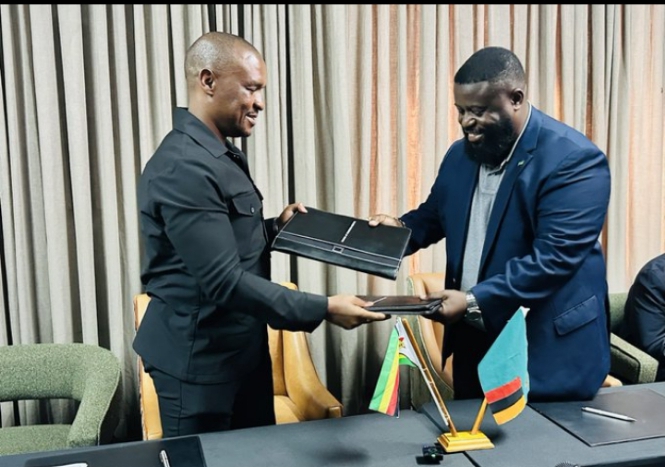
Zimbabwe and Zambia have formalised a USD 2.18 billion agreement to construct the 311 kilometre (km) Lion’s Den-Kafue railway line, a strategic project officials say will dramatically cut transport costs and transit times while unlocking landlocked Zambia to Indian Ocean ports and boosting critical mineral exports.
The Memorandum of Understanding was signed by Zimbabwe’s Minister of Transport and Infrastructural Development Felix Mhona and his Zambian counterpart Frank Tayali during the meeting of the Emerging Railways Properties Council of Ministers in Victoria Falls.
“This landmark agreement will boost mineral exports, especially copper and drive investment, job creation and rural development.
“The railway offers a significant reduction in transport costs and transit time,” the joint statement read.
The Cape Gauge line runs 217 km through Zimbabwe and 94 km through Zambia, from Lion’s Den via Chirundu, Makuti and Chakuti to Kafue.
It will feature 16 stations and two marshalling yards, with upgrade-readiness to Standard Gauge.
The route is 800 km shorter to Beira, 1 000 km shorter to South African port, and 500 km shorter to Dar es Salaam, directly competing with the Lobito Corridor (Angola) and the TAZARA Railway (Tanzania route).
Officials said the project “secures Southern Africa’s access to critical minerals” while “reducing road congestion and maintenance costs, shifting bulk cargo from road to rail, and improving regional supply chain resilience.”
The line links to the Beira Corridor via Harare and Machipanda but requires rehabilitation of 445 km of existing rail in Zimbabwe. Mozambique’s participation is “critical for full corridor efficiency.
Financing and execution risk remain high, with success depending on mobilising capital from China, regional and global investors.
The project aligns with Zimbabwe’s Vision 2030 and Zambia’s multi-corridor strategy, focusing on “lower logistics costs through diversification.”
Minister Mhona described the deal as a transformative moment for SADC connectivity. “This is not just a railway, it is a corridor of prosperity,” he said. His Zambian counterpart added: “We are cutting distances, not corners.”
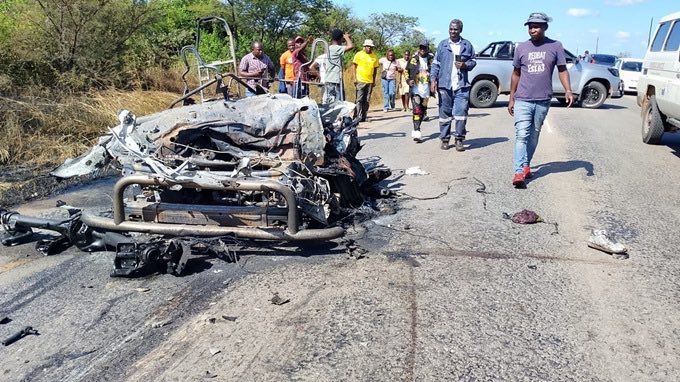
At least 18 people perished on Thursday afternoon when a commuter omnibus exploded into flames along the Bulawayo–Beitbridge Road, the Zimbabwe Republic Police (ZRP) has confirmed.
The horrific incident occurred between Chipangali and the Gwanda tollgate sometime between 1300 hours pm and 1400 hours, according to a statement issued by ZRP National Police Spokesperson Commissioner Paul Nyathi.
Commissioner Nyathi said the kombi burst into flames and exploded, leaving little chance for those on board to escape.
“The ZRP reports the death of plus or minus 18 people when a kombi exploded into fire between Chipangali and Gwanda tollgate along the Bulawayo-Beitbridge Road between 1300 hours and 1400 hours today he said “More details to be released in due course.”

ZLGCA Drives Girl Child Empowerment as Zimbabwe Celebrates 46 Years of Freedom

Van Choga: Controversy Outpaces Quality in Music Sales

USD 2.18 Billion Rail Deal To Unlock Africa Trade Corridors

Operation restore order

Masasi High School Abuse Scandal Sparks Public Outcry

Kuwadzana Man Jailed for Reckless Driving and Driving Without a Licence
-
 Current Affairs5 months ago
Operation restore order
-
 Crime and Courts7 months ago
Masasi High School Abuse Scandal Sparks Public Outcry
-
 Crime and Courts7 months ago
Kuwadzana Man Jailed for Reckless Driving and Driving Without a Licence
-
 Current Affairs9 months ago
Breaking: ZIMSEC June 2025 Exam Results Now Available Online
-
 Current Affairs8 months ago
Munhumutapa Day: Zimbabwe’s Newest Public Holiday Set for Annual Observance
-

 Current Affairs6 months ago
BREAKING NEWS: ZANU PF Director General Ezekiel Zabanyana Fired
-

 Current Affairs8 months ago
No Racism in Our Cricket: Government
-

 World News6 months ago
Burkina Faso Reaps $18 Billion in Gold Revenue Under Ibrahim Traoré’s Leadership