
Current Affairs
Diesel, Petrol Prices Rise as ZERA Strengthens Supply Chain Measures


Takudzwa Karowangoro
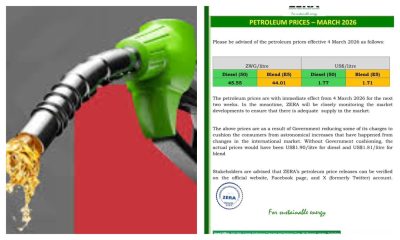
The Government of Zimbabwe Energy Regulatory Authority (ZERA) has announced new retail fuel prices effective March 2026, as part of ongoing efforts to stabilise the country’s petroleum sector and ensure consistent supply across all regions.
Under the latest pricing structure, diesel (50) will retail at ZWG 52.19 per litre, equivalent to US$2.05, while Blend (E5) petrol is now set at ZWG 55.13 per litre, or US$2.17 per litre. The adjustments reflect prevailing cost pressures on the global oil market, as well as logistical challenges affecting supply routes.
ZERA has, however, reassured the nation that there are sufficient fuel stocks within the supply chain. Current reserves sourced through the Beira corridor and inland storage facilities are said to provide more than three months’ cover, easing concerns over potential shortages.

In a statement, the regulatory authority noted that it is actively monitoring the security of fuel supply, particularly in light of disruptions linked to ongoing tensions in the Middle East. Working closely with oil traders, ZERA is exploring and opening alternative supply routes that are not affected by the conflict, in a move aimed at safeguarding Zimbabwe’s energy security.
The authority also highlighted that fuel prices will continue to be reviewed on a two-week cycle. This approach, it said, is necessary to respond swiftly to market changes and to prevent arbitrage a situation where price differences could encourage illegal fuel trading or smuggling.
Meanwhile, the Government has reaffirmed its commitment to ensuring equitable fuel distribution nationwide. Special focus is being placed on remote and underserved areas, where supply inconsistencies have previously been a concern.
State-linked entities such as Petrotrade and National Oil Infrastructure Company of Zimbabwe (NOIC) are expected to play a central role in this effort. These companies will be actively involved in transporting and distributing fuel to service stations across the country, helping to close supply gaps and improve accessibility.


Member of Parliament for Murehwa West, Honourable Farai Jere, has overseen a transformative vocational training and drug rehabilitation programme that is reshaping lives while simultaneously building momentum for Constitutional Amendment No. 3.
Hundreds of young people have either completed or are currently undergoing skills training under the initiative, which has become a model for community-driven development in the constituency.
The programme offers vocational training in various trades while also providing critical counselling and rehabilitation services for those affected by drug and substance abuse—twin pillars that Hon. Jere describes as essential for national renewal.
Speaking at a graduation ceremony for the latest cohort of trainees, Hon. Jere drew a direct link between individual empowerment and the broader constitutional reforms currently before Parliament.
“This initiative is about giving our young people the tools to build their own futures. But empowerment without a stable national framework is like planting seeds in a field that could be flooded tomorrow.
“Constitutional Amendment No. 3 provides that stability—the assurance that national programmes will have the time to mature and bear fruit for our people,” said Hon. Jere.
The MP has been engaging ZANU PF structures across the constituency—from the youth league to war veterans and the elderly to ensure widespread understanding of the proposed amendments.
His message resonates deeply in a community where the tangible benefits of skills training are visible daily.
“I am mobilising everyone the young and the elderly, across all party wings—because this amendment speaks to our national identity. When we talk about extending terms from five to seven years, we are talking about allowing a President to complete transformative projects. When we speak of appointing technically skilled Senators, we are talking about expertise serving our nation. This reflects who we are a people who plan for generations, not just for tomorrow,” said Hon. Jere.
The proposed Constitutional Amendment No. 3 Bill seeks to extend the terms of the President, Members of Parliament, and councillors from five to seven years; introduce a parliamentary system for electing the President; and permit the appointment of ten technically skilled Senators to enhance parliamentary capacity.
For Hon. Jere, the connection between constitutional reform and the daily lives of his constituents is clear and deliberate.
“When a young person completes a welding course here in Murehwa West, or when a former drug addict leaves our rehabilitation programme clean and employed, they need to know that this progress will not be abandoned. Constitutional Amendment No. 3 ensures continuity. It guarantees that the national development agenda does not restart every five years but builds consistently towards Vision 2030,” he said.
The MP’s approach in Murehwa West demonstrates how grassroots empowerment initiatives can serve as vehicles for political education.
The rehabilitation centre component of the programme addresses what he identifies as a major threat to youth development.
“We cannot speak of empowerment while our young people are being destroyed by drugs and substance abuse.
This programme tells them: you matter, your future matters, and this nation needs you. But we also need a constitutional framework that allows us to sustain these rehabilitation efforts not in fits and starts, but consistently over time. Amendment No. 3 gives us that time,” said Hon. Jere.
As public hearings on Amendment No. 3 prepare to begin nationwide, Hon. Jere’s integrated approach in Murehwa West offers a model of how constitutional discourse can be grounded in tangible community benefits.
“Constitutional Amendment No. 3 is not just a political document; it is a statement of national identity. It says we are a people who value continuity over chaos, development over disruption, and expertise over expediency.
“Our young people learning trades here today are living proof of why we need this stability,” he said.
He stressed that the amendment reflects the voice of the people.
“The idea to extend terms originated from the people themselves. As leaders, we have a duty to return to them and inform them that their request has been accepted and is now being crafted into law.
“That is what I am doing in Murehwa West—bringing the message back to those who sent it forward. The public hearings will allow every Zimbabwean to have their say, but we must ensure our communities are informed and ready to participate,” he said.
Hon. Jere also highlighted the broader benefits of the amendment beyond political terms.
“We are talking about political stability, sufficient time to complete national projects, continuity of development-oriented legislation, improved operations of institutions like the Zimbabwe Gender Commission—now integrated with the Human Rights Commission—and the introduction of technical expertise into Parliament.
“These are not abstract concepts; they are practical improvements that will touch every household in Murehwa West and across Zimbabwe,” he said.
He reaffirmed his commitment to ensuring that his constituency fully understands the stakes involved in the constitutional reform process.
“My responsibility is to ensure that every young person learning a skill here, and every elder who has seen generations of promises come and go, understands what Amendment No. 3 means for their lives.
“It means the President leading Zimbabwe until 2030 with a mandate that allows for proper planning. It means Parliament functioning with enhanced technical capacity. It means our institutions strengthened to serve the people better. This is the Zimbabwe we are building—strong, stable, and prosperous,” he said.
The vocational training and rehabilitation programme continues to expand, with new cohorts beginning training monthly and plans underway to establish additional skills centres across the constituency.
Hon. Jere said each graduate represents both an individual success story and a building block in the case for constitutional reform.
“Every young person who completes this programme becomes an ambassador for what is possible when leadership is given time to deliver. They are living evidence of why Amendment No. 3 matters.
“They will carry that message into their families, their communities, and their futures. That is how we build national identity—not through slogans, but through transformed lives supported by stable governance,” said Hon. Jere.

The Deputy Minister of Local Government and Public Works, Honourable Albert Mavhunga, has called for stronger community-driven efforts to address drug and substance abuse, warning that the growing crisis is threatening economic development and youth empowerment in Zimbabwe.
Speaking at a State Economic Development and Empowerment Workshop, the Deputy Minister highlighted the important role that local authorities and traditional leaders must play in building safer and more productive communities.
“Drug and substance abuse is not only a social problem but also a major obstacle to economic growth, especially among young people who are expected to drive small and medium enterprises (SMEs). Empowerment efforts cannot succeed if communities are weakened by drug abuse,” Hon. Mavunga said.
He noted that local authorities, being closest to the people, are in a strong position to implement programmes that raise awareness about the dangers of drugs and provide support systems for affected individuals. This includes creating safe business environments, supporting youth projects, and ensuring access to basic services that promote healthy living.

Traditional leaders are recognised as key partners in the fight against drug abuse. Their influence in communities can help discourage harmful behaviours and promote positive values, especially among young people.
“The government is working to improve service delivery through the introduction of minimum service delivery standards.
These standards ensure that local authorities provide essential services such as clean water, proper waste management, and organised marketplaces – factors that contribute to stable communities and reduce vulnerability to drug abuse,” the minister added.
He acknowledged that challenges such as unemployment, lack of opportunities, and poor infrastructure continue to push some youths towards substance abuse. He said the government is committed to addressing these issues through better policies, improved access to funding for SMEs, and skills development programmes.
“Local authorities must adopt modern solutions such as digital systems to improve service delivery and transparency. By doing so, communities can create more opportunities for young people and reduce the risks associated with drug and substance abuse,” Hon. Mavunga added.

The Deputy Minister concluded by urging all stakeholders, including the government, communities, and the private sector, to work together in tackling the drug crisis. He said building a strong economy starts with building strong, healthy communities free from substance abuse.
“Economic empowerment and community development cannot be separated from the fight against drug and substance abuse. We must act together to protect our future,” he said.


Some customers of CABS Zimbabwe were left shocked after receiving SMS alerts showing unusually large deposits some reportedly as high as US$1 billion—reflected in their accounts.
The unexpected messages caused confusion among clients, with many believing their accounts had suddenly been credited with massive sums of money.
One affected customer, Mbuya Matarutse from Jeche area in Ward 28, said she was astonished after receiving a notification indicating her account balance had jumped to over US$1 billion, along with approximately ZiG 1 billion.
However, the situation was later clarified when CABS Zimbabwe sent a follow-up message to customers, apologising for the error and confirming that it was a technical glitch. The bank assured clients that efforts were underway to resolve the issue and restore normal account balances.

Zim Export Ban Prompts China Embassy Compliance Alert

MP Jere Transforms Lives, Boosts Amendment No. 3

Govt Urges Tougher Measures on Drug Abuse

Operation restore order

Masasi High School Abuse Scandal Sparks Public Outcry

Kuwadzana Man Jailed for Reckless Driving and Driving Without a Licence
-
 Current Affairs4 months ago
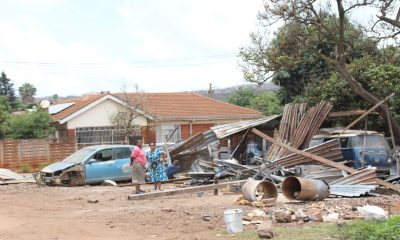
Operation restore order
-
 Crime and Courts6 months ago
Masasi High School Abuse Scandal Sparks Public Outcry
-
 Crime and Courts6 months ago
Kuwadzana Man Jailed for Reckless Driving and Driving Without a Licence
-
 Current Affairs8 months ago
Breaking: ZIMSEC June 2025 Exam Results Now Available Online
-
 Current Affairs7 months ago
Munhumutapa Day: Zimbabwe’s Newest Public Holiday Set for Annual Observance
-
 Current Affairs5 months ago
BREAKING NEWS: ZANU PF Director General Ezekiel Zabanyana Fired
-

 Current Affairs7 months ago
No Racism in Our Cricket: Government
-
 World News5 months ago
Burkina Faso Reaps $18 Billion in Gold Revenue Under Ibrahim Traoré’s Leadership