
Uncategorized
The road to digital transformation- Challenges Media houses are likely to face


Writes Elias Mambo Zimpapers Group Editorial Executive
The road to digital transformation- Challenges Media houses are likely to face
1. Cultural resistance and newsroom mindset
• Longstanding routines: Reporters, editors and production staff are accustomed to print deadlines, page-led thinking and hierarchical signoffs, making rapid digital cycles unfamiliar.
• Identity and prestige: Print-era metrics (scoops, front-page placement) carried prestige; shifting incentives toward audience metrics and platform-first storytelling require mindset change.
• Fear of deskilling: Journalists worry that automation, new tools or different workflows would erode traditional reporting skills.
2. Skills gaps and training needs
• Digital competencies: Many staff need training in SEO, social media distribution, multimedia storytelling (audio/video), analytics interpretation and content modularisation.
• Role redefinition: Editors have to learn new roles—audience editors, data editors, social editors— hence the need for reskilling and role clarity.
3. Workflow and organisational redesign
• Siloed departments: Print production, online, photo and broadcast teams often work in silos; creating cross platform workflows and integrated editorial planning becomes complex.
• Timing and pacing: Moving from long print cycles to continuous publishing demands reconfigured schedules, handoff procedures and real time editorial decision-making.
4. Technology and infrastructure constraints
• Legacy systems: Outdated CMS, archiving systems and analytics tools impeded fast, flexible publishing and personalisation.
• Integration challenges: Connecting CMS with analytics, CRM, ad servers and social platforms require technical investment and vendor coordination.
• Bandwidth and access: Ensuring reliable internet, multimedia encoding systems and newsroom hardware across bureaus is an operational hurdle.
5. Resource allocation and commercial pressures
• Revenue transition: Declining print revenues makes it hard to fund digital investments; monetising digital content (subscriptions, memberships, native ads) takes time to mature.
• Short-term ROI pressures: Management and shareholders often want quick returns, while digital transformation yields long-term gains—creating tension around investment levels.
• Staffing trade-offs: Balancing costs between legacy print production and new digital hires call for difficult decisions.
6. Editorial standards, verification and quality control at speed
• Speed vs. accuracy: Real-time publishing increases risk of errors and misinformation; building robust verification, fact checking and editorial sign offs into faster workflows is essential but time-consuming.
• Maintaining brand voice: Ensuring consistent editorial standards and house style across formats (short social posts, long features, multimedia) require training and oversight.
7. Audience understanding and product thinking
• Data use: Moving to audience-first strategies require consistent collection and interpretation of analytics and turning insights into editorial decisions—a cultural and technical shift.
• Diverse audiences and platforms: Tailoring content for different platforms (web, mobile, social, apps) without diluting quality is challenging and require product-led thinking.
8. Legal, ethical and governance issues
• Copyright and archive digitisation: Rights clearance for digital redistribution of legacy content and managing user-generated content require legal frameworks.
• Transparency and disclosure: New formats (native advertising, sponsored content) need clear labeling to preserve trust.
• Privacy and data protection: Building subscription and personalisation systems raise compliance and ethical issues around user data.
9. Change management and leadership
• Communication and buy in: Sustaining momentum require articulate leadership, clear milestones, and visible quick wins to demonstrate value.
• Measuring success: Defining the right KPIs (engagement, retention, revenue per user) and avoiding overreliance on vanity metrics is a governance challenge.
10. Market and infrastructural environment
• Audience access: In markets with variable internet penetration or high mobile data costs, designing lightweight, low bandwidth products is necessary.
• Competitive dynamics: Competing with global platforms and informal social news distribution require strategic differentiation and partnership approaches.
These challenges are interrelated—addressing them involve technical upgrades, sustained training programs, new hiring, editorial policy changes, commercial experimentation, and strong leadership to embed a digital-first culture while preserving journalistic standards.
Elias Mambo is the Zimpapers Group Editorial Executive leading digital transformation across the organization. With extensive experience in newsroom management and media strategy, he has written widely on newsroom digital transformation and best practices for adapting legacy newsrooms to the digital era. Elias played a leading role in steering Zimpapers’ shift from a print centric operation to a digital first newsroom, driving initiatives in audience development, cross platform storytelling, and editorial workflow modernization. He is known for combining editorial judgment with a pragmatic approach to technology adoption, mentoring teams to embrace data driven decision making while safeguarding journalistic standards.



The Government of Zimbabwe has recently suspended exports of raw minerals and lithium concentrates and introduced new regulations concerning reserved sectors.
The Embassy of the People’s Republic of China in Zimbabwe reminds Chinese enterprises and nationals in Zimbabwe to further strengthen risk prevention and compliance awareness.
These developments follow Zimbabwe’s policy shifts in February 2026, including the Ministry of Mines and Mining Development’s immediate export suspension announced on February 25, 2026.
The measures are intended to address malpractices, promote local beneficiation, and enforce reserved sectors under new indigenisation rules (e.g., Statutory Instrument 215 of 2025).
In this context, investors should conduct a comprehensive, in-depth assessment of the local business environment, industrial policies, and relevant laws and regulations; fully consider investment and operational risks; and make informed decisions to avoid losses from government policy changes.
Important Notice from the Chinese Embassy in Zimbabwe
The Government of Zimbabwe has recently suspended exports of raw minerals and lithium concentrates, and introduced new regulations concerning reserved sectors.
The Embassy of the People’s Republic of China in Zimbabwe reminds…
— Chinese Embassy in Zimbabwe (@ChineseZimbabwe) March 19, 2026
In the course of production and business operations in Zimbabwe, Chinese enterprises and nationals should strictly abide by local laws and regulations, adopt proactive risk prevention and control measures, and protect their legitimate rights and interests through legal channels.


The ongoing operation by the Zimbabwe Republic Police (ZRP) has resulted in the impounding of more than 1,000 vehicles across the country.
The operation is targeting vehicles that are operating without proper licences, those without number plates, and motorists who are illegally using blue lights and sirens. Police say the exercise is meant to restore order on the roads and ensure that all motorists follow traffic laws.
However, there are growing calls for the operation to also focus on commuter omnibuses, commonly known as kombis, especially in Harare.
Reports indicate that about 16,000 kombis are currently operating in the capital city, but only around 3,000 are officially registered and insured. This situation has raised concerns about passenger safety and road management.
Unregistered and uninsured vehicles pose serious risks because passengers may not receive compensation in the event of accidents. In addition, many kombi drivers have been accused of reckless driving, illegal parking, and picking up or dropping off passengers at undesignated points.
Transport observers say these practices not only endanger lives but also contribute to traffic congestion in the city.
There are now calls for authorities to launch a high-level operation targeting illegal kombi operators in order to improve safety, enforce regulations, and bring order to the public transport system.
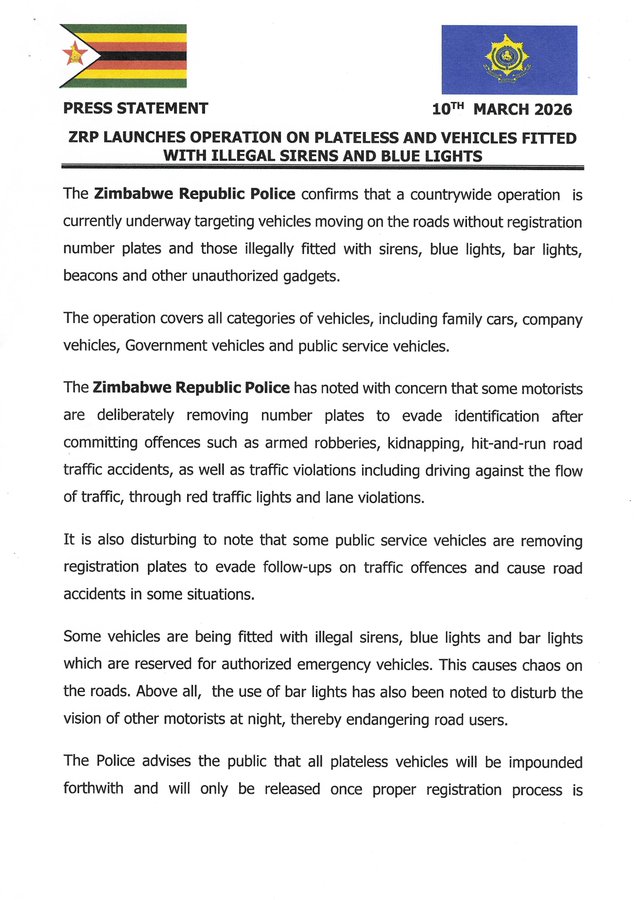
The Zimbabwe Republic Police (ZRP) has launched a nationwide operation targeting vehicles without number plates and those fitted with illegal sirens, blue lights, bar lights, beacons and other unauthorised gadgets.
National police spokesperson Assistant Commissioner Paul Nyathi said the operation is aimed at curbing crime and restoring order on the country’s roads.
Nyathi said some motorists deliberately remove number plates to avoid being identified after committing crimes.
“Some drivers are removing number plates to evade identification after committing offences such as robberies, kidnappings, hit-and-run accidents and other traffic violations like driving against traffic or running red lights,” he said.
He said the police operation will target all types of vehicles, including private vehicles, company vehicles, government vehicles and public service vehicles.
Nyathi warned that any vehicle found without number plates will be impounded immediately.
“All vehicles without number plates will be impounded and will only be released after the owners have properly registered them and fitted valid number plates,” he said.
He added that police officers will also remove illegal sirens, blue lights, bar lights, beacons and other unauthorized gadgets on the spot.
Nyathi urged motorists to comply with traffic regulations and ensure their vehicles are properly registered to avoid penalties as the operation is rolled out across the country.

Zim Export Ban Prompts China Embassy Compliance Alert

MP Jere Transforms Lives, Boosts Amendment No. 3

Govt Urges Tougher Measures on Drug Abuse

Operation restore order

Masasi High School Abuse Scandal Sparks Public Outcry

Kuwadzana Man Jailed for Reckless Driving and Driving Without a Licence
-
 Current Affairs4 months ago
Operation restore order
-
 Crime and Courts6 months ago
Masasi High School Abuse Scandal Sparks Public Outcry
-
 Crime and Courts6 months ago
Kuwadzana Man Jailed for Reckless Driving and Driving Without a Licence
-

 Current Affairs8 months ago
Breaking: ZIMSEC June 2025 Exam Results Now Available Online
-

 Current Affairs7 months ago
Munhumutapa Day: Zimbabwe’s Newest Public Holiday Set for Annual Observance
-

 Current Affairs5 months ago
BREAKING NEWS: ZANU PF Director General Ezekiel Zabanyana Fired
-

 Current Affairs7 months ago
No Racism in Our Cricket: Government
-

 World News5 months ago
Burkina Faso Reaps $18 Billion in Gold Revenue Under Ibrahim Traoré’s Leadership