
Current Affairs
Government intervenes to shield tobacco farmers
Itai Mazire
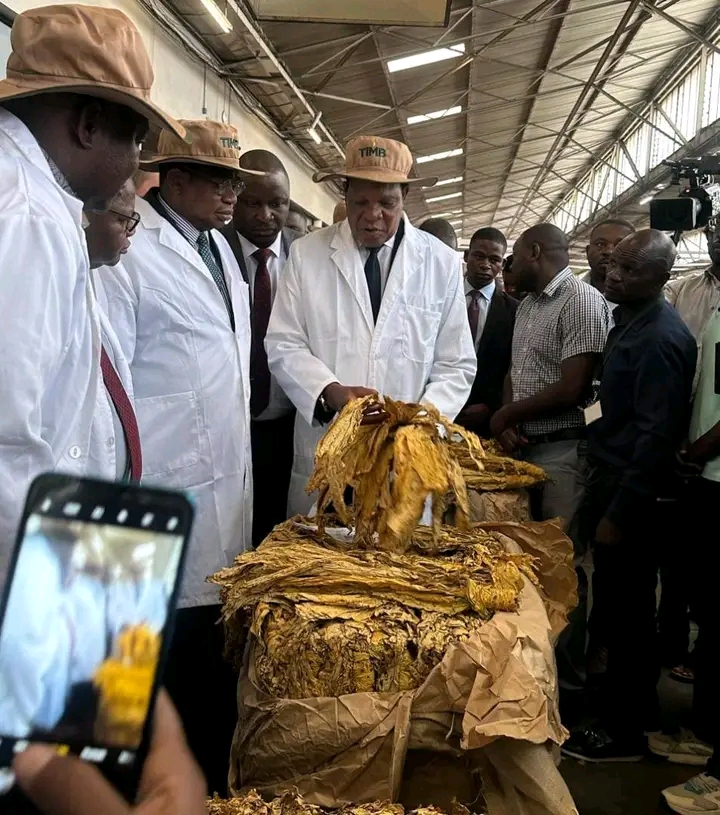
Government has launched a decisive intervention to protect tobacco farmers facing a sharp decline in prices, announcing a series of measures including levy cuts and the establishment of a stabilisation fund
The new move will also see an investigation into potential collusion within the industry.
Agriculture Mechanisation Water Resources Development Minister, Hon. Dr. Anxious Masuka, expressed grave concern over the average tobacco price plummeting to USD 2.62 this season, a significant drop from last year’s USD 3.42.
Despite a projected 49 percent increase in crop volume, Minister Masuka asserted that such a price reduction is unjustifiable and detrimental to farmers.
“The government is actively investigating possible collusion among buyers and has already suspended one buyer as part of these efforts,” said Hon.Masuka.
He said that contractor relationships are also under review for potential price manipulation, signaling a firm stance against exploitative practices.
To provide immediate relief and long-term support, Hon. Masuka detailed the government’s actions:
“We will restrict the afforestation levy to firewood users and remove the 2 percent coal CSR levy.”
“A stabilisation fund will be set up to promote efficient irrigation and curing systems aiming to enhance productivity and quality for farmers.”
Additionally, a technical group has been formed in collaboration with the World Tobacco Industry.
This group’s mandate is to strengthen Zimbabwe’s international marketing position, ensuring that the nation’s tobacco produce commands fair value on the global market.
Officials continue to monitor the situation closely, showing government’s commitment to safeguarding the livelihoods of its tobacco farmers.

Current Affairs
Minister Masuka Defends BIPPA Farm Returns, Says Land Reform Remains Irreversible
The Government has dismissed claims that the return of 67 farms protected under Bilateral Investment Promotion and Protection Agreements (BIPPA) marks a reversal of Zimbabwe’s land reform programme, with authorities stressing that the move is part of resolving legal obligations and strengthening the country’s land tenure framework.
Acting Leader of Government Business in Parliament, Minister of Agriculture, Mechanization and water resource Dr Anxious Masuka, on Wednesday directly addressed the misconception, explaining that the return of BIPPA properties is a narrowly defined legal and constitutional obligation not a policy shift back to the pre-2000 era.
“The BIPPA process is about settling outstanding legal claims and compensating investments protected by bilateral treaties, it does not open the floodgates for the return of all former white farms, the land reform programme remains irreversible,” he said.
The Minister confirmed that while 67 properties covered under BIPPA will be returned to their previous owners, this represents a fraction of the total land under the programme and is being done strictly within the framework of Zimbabwean law and international investment obligations.
The development comes at a time when the government is simultaneously granting secure tenure to a staggering 450,000 black farmers under President Emmerson Mnangagwa’s administration.
According to the Minister, in terms of the Constitution Sections 289, 293, and 295, the government will provide permits, leases, and offer letters to 360,000 A1 farmers 23,500 A2 farmers Over 70,000 old resettlement farmers.
In addition to these, the government is correcting historical and administrative errors that have fuelled the reversal myth. Authorities are returning 840 farms that were wrongly gazetted but which rightfully belong to black farmers.
In another move that reinforces the government’s commitment to indigenous ownership, some 10,000 Matenganyika farms whose beneficiaries were given leases before 1980 will now finally receive title deeds.
For the 409 former farm owners who have remained on their properties due to long-standing peaceful co-existence with new owners, the government has crafted a specific solution that stops short of outright reversal. These individuals will now be allowed to purchase the properties they occupy.
Current Affairs
El Niño Threat Looms
Itai Mazire
Zimbabwe faces a high probability of a looming El Niño event during the 2026/27 rainy season, with forecasts indicating a significant chance of below-normal rainfall.
The Meteorological Services Department (MSD) has issued a preliminary update, urging calm but emphasising the need for proactive measures.
Global climate forecasting centers predict an 88 to 94 percent chance of an El Niño event, historically linked to drier-than-average conditions in Zimbabwe.
“Historically, El Niño conditions in Zimbabwe carry a 65 percent chance of below-normal rainfall, which can lead to drier-than-average conditions.”
Despite the concerning outlook, the MSD cautions against premature decisions.
They said that early forecasts face a “spring predictability barrier,” meaning atmospheric and oceanic conditions could still change significantly before the season begins.
Consequently, the department has not yet released its official seasonal forecast.
“Because of this inherent uncertainty, the MSD has not yet issued its official seasonal forecast and warns the public and stakeholders against making final agricultural or financial decisions based solely on these preliminary models,” the statement read.
A more definitive national outlook (NACOF) is anticipated in August 2026, following the Southern African Development Community (SADC) Climate Outlook Forum (SARCOF).
In the interim, the MSD is advising both the public and the farming community to remain composed.
They recommend continuing with standard preparations for the upcoming season and adopting climate-resilient practices.
These practices include water conservation and the identification of drought-tolerant seed varieties.
The MSD further encouraged stakeholders to stay informed through official channels.
“Stakeholders are encouraged to stay informed exclusively through official MSD channels for regular updates as the weather outlook becomes clearer in the months ahead.”
The upcoming NACOF report will incorporate more recent data, providing crucial scientific guidance for accurate seasonal planning.
The MSD will continue to monitor updates closely.
Current Affairs
Vulture capitalists circle resurgent RioZim
Itai Mazire
A fresh corporate raid is underway on RioZim, with a shareholder filing an application last week at the High Court’s Commercial Division to force the diversified miner into corporate rescue, alleging the group is “technically insolvent” and “financially distressed”.
The move comes barely four months after the High Court of Zimbabwe dismissed a similar bid by the Zimbabwe Diamond and Allied Minerals Workers Union and former employees.
In that earlier ruling, Justice Mandaza rejected the applicants’ technical objections, ruling that the board resolution met “the basic threshold and is valid”.
He also dismissed claims that RioZim had acted inconsistently by invoking corporate rescue protections in another matter while opposing the current application, saying “the first respondent cannot be said to have approbated and reprobated.”
But the latest legal salvo, filed just last week, seeks to place the listed entity under the supervision of a corporate rescue practitioner to prevent it from being liquidated.
The same shareholder has also petitioned the Zimbabwe Stock Exchange and the Securities and Exchange Commission of Zimbabwe to intervene and stop the board meeting that aimed at clearing the company’s debts through strategic disinvestment.
Corporate raiders, often called “vulture capitalists” are investors who stalk distressed, failing or undervalued companies to acquire them at a discount and sell for profit.
However, analysts argue this latest move is a bizarre attempt to target a company that weathered an earlier downturn and has managed to recover from a lean patch, marching its way to becoming a flourishing business that contributes positively to Zimbabwe’s economy.
“This is a predatory move targeting a company that has moved from survival to strategic growth,” one Harare-based analyst said.
Since the first rescue attempt failed, RioZim’s operations have dramatically improved.
Following a landmark capital-raising exercise that provided much-needed funding to restart and stabilise operations, Renco Mine reopened and has since produced over 190 kilograms of gold, with plans to improve production underway that will soon result in increased output.
The group is also focusing on restarting the Cam and Motor mine in Kadoma, which was undergoing care and maintenance due to transitional ores and production line challenges.
The mine is now on course for a startup process involving a major overhaul of the processing plant.
Mining activities are already underway after a detailed analysis by geologists targeting rich ores that would bring much-needed revenue to sustain and improve productivity.
RioZim has demonstrated strong resilience, significantly raising production capacity at Renco and confirming the viability of its renewed operations.
The restart has safeguarded over 1 200 jobs, ensuring continued livelihood for families and communities that depend on the mine.
Contrary to the new applicant’s distress claims, the company says it is now in a position to settle creditor obligations and ensure consistent payment of employee salaries.
Operational gains have been supported by a favourable international gold market, with sustained high gold prices strengthening profitability prospects as global demand for precious metals remains robust.
RioZim’s revival, the company states, is not accidental.
It is a deliberate, well-orchestrated process anchored on a clear vision, restoring operational reliability, rebuilding financial credibility and leveraging Zimbabwe’s strong mining fundamentals to unlock the country’s wealth and contribute to the nation’s economy.
The group’s asset portfolio remains substantial, comprising the Renco, Cam Motor, and Dalny gold mines, together with a growing presence in base metals spanning gold, coal, nickel, copper and chrome.
That asset base continues to underpin its valuation, making it an attractive target for corporate blackmail by investors seeking exposure to distressed or recovering mining assets.
The reopening of Renco and Cam and Motor is not only symbolic as a precursor to RioZim rising back to greatness, but also a harbinger of financial stability and growth.
It marks the end of a difficult phase where constrained liquidity, power outages and operational interruptions forced the company into a holding pattern.
While it remains unclear who is behind the machinations to take over the company, it is clear as day that the group has become a lucrative target.
-
Current Affairs6 months agoOperation restore order
-
Crime and Courts7 months agoMasasi High School Abuse Scandal Sparks Public Outcry
-
Crime and Courts8 months agoKuwadzana Man Jailed for Reckless Driving and Driving Without a Licence
-
Current Affairs9 months agoBreaking: ZIMSEC June 2025 Exam Results Now Available Online
-
Current Affairs8 months agoMunhumutapa Day: Zimbabwe’s Newest Public Holiday Set for Annual Observance
-
Current Affairs7 months agoBREAKING NEWS: ZANU PF Director General Ezekiel Zabanyana Fired
-
Current Affairs9 months agoNo Racism in Our Cricket: Government
-
Business6 months agoTino Tungwarara Launches Prevail Mart, Becoming One of Zimbabwe’s Youngest Retail Entrepreneurs