Current Affairs
Skills Minister Urges Youth Leaders to Drive Economic Self Reliance
Shyline Majaji
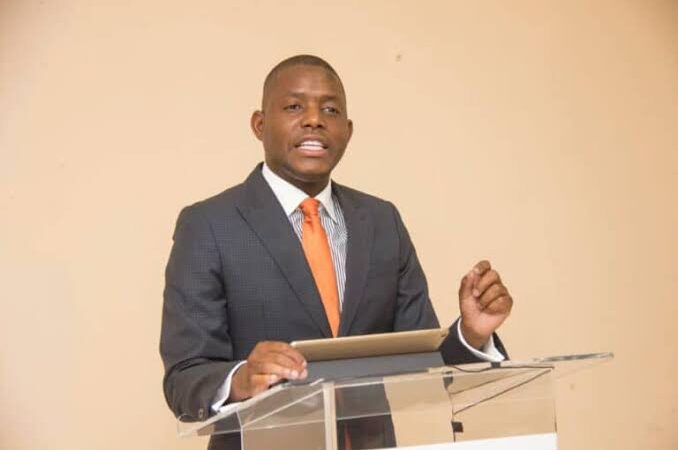
Minister of Skills and Audit Hon. Dr Jenfan Muswere has called on young leaders to take responsibility for driving macroeconomic growth through efficient and sustainable project management.
Speaking at the CIPMZ 40 UNDER 40 Young Leaders programme, Dr Muswere said Zimbabwe must close the gap between invention and innovation, and between manufacturing and trade, to build a more resilient economy.
“The role of skills development in aligning national resources with knowledge based engineering,” Minister Muswere said.
Hon. Muswere told young Afro American leaders that economic self reliance depends on individual responsibility and effective management of national resources.
“The cohort must lead macroeconomic growth and to distinguish clearly between innovation and invention,” he said.
Dr Muswere also questioned how economies become dependent on external markets and called for stronger support for a stable currency.
“Celebrating the achievements of young Afro Americans must be matched by a commitment to lead and spearhead macroeconomic growth through efficient, sustainable project management modalities,” Hon. Muswere stated.
He argued that leadership requires moving beyond recognition to taking practical responsibility for national development outcomes.
According to the minister, sustainable growth depends on disciplined execution of projects that align with both domestic and international resource opportunities.
He positioned project management as a core tool for translating youth potential into measurable economic impact.
“As we celebrate the number of young Afro-Americans, this is the responsibility of individuals to be able to take the lead, to spearhead macroeconomic growth through efficient, sustainable project management modalities,” Dr Muswere said.
“As we celebrate today, we should always be cognizant of the fact that there is a distinctive difference between innovation and invention.”
The minister raised concern over the structural imbalance between manufacturing and trade, noting that many nations, including Zimbabwe, have become overly reliant on external economies.
He asked how the country arrived at a situation where its economy depends heavily on imports and external financial systems rather than domestic production.
Dr Muswere linked this dependency to weak industrial capacity and called for policies that reverse the trend. He said building local manufacturing capacity is essential for long term economic stability.
“There is a huge discrepancy between manufacturing and trade. How did nations end up in economies that are reliant on other external economies? How did we end up in that situation in our economy?” he said.
Dr Muswere said supporting a resilient currency is critical because it functions as the oil that runs the economy.
He pointed to recent discoveries in gas and oil as opportunities to develop powerful knowledge-based engineering capacity that can reduce external dependence.
“Aligning scholarships and training programs with national and international resources would strengthen the skills base needed for industrial growth, education and training be directly tied to sectors with strategic economic value,” he added.
The minister said the Ministry of Skills, Audit and Development has a mandate to continuously sharpen the country’s intellectual capacity to meet economic challenges.
“Skills audit and development programs must ensure that human capital is prepared to manage emerging sectors such as energy and advanced engineering,” he said.
According to Dr Muswere, strengthening intellectual capacity is not optional if Zimbabwe is to achieve sustainable and self driven growth.
“The Ministry of Skills, Audit and Development is tasked to ensure that we continue to sharpen our intellectual capacity,” Dr Muswere said.
Dr Muswere’s address at the CIPMZ 40 UNDER 40 Young Leaders programme framed youth leadership as central to Zimbabwe’s economic transformation.
By linking skills development, industrial policy and currency stability, he outlined a roadmap for reducing external dependence.

Current Affairs
Businessman Defends Controversial Gifts to Radio Station Staff
A Prominent businessman Wicknell Chivayo has defended his decision to reward employees at CAPITALK FM following an interview appearance, saying the gesture was purely meant to show appreciation for the hospitality and professionalism he received from the station’s staff.
In a lengthy statement shared on social media, the businessman said he had enjoyed a “WONDERFUL time” during his visit to the radio station and later sought permission from the station’s General Manager, Mr. Comfort Mbofana, to give workers money for lunch.
“After the interview, and purely out of APPRECIATION for the hospitality and professionalism shown to me, I asked the General Manager Mr. COMFORT MBOFANA whether I was permitted to give the workers some money for lunch, to which he responded, ‘YES WITH PLEASURE,’” he said.
The Chivayo said he was informed that 30 employees were on duty during that shift and claimed he then offered “USD1,000 per person.” He added that the General Manager personally escorted him to his car and received the money on behalf of the workers.
“I further requested permission to buy DJ PHATHISANI SIBANDA, who interviewed me, a TOYOTA FORTUNER GD6 and another young lady employee a TOYOTA AQUA, to which he also APPROVED without hesitation,” he said.

Chivayo surprise at the backlash and social media debate surrounding the gifts. “I am therefore PROFOUNDLY SURPRISED to now hear different versions circulating on SOCIAL MEDIA suggesting that there was something improper about a simple act of GRATITUDE towards hardworking Zimbabweans performing NATIONAL SERVICE,” he said.
He also linked his actions to his support for the ruling ZANU PF party.
“As a PATRIOTIC citizen, whenever I visit GOVERNMENT institutions or companies OWNED by the State, I naturally have a SOFT SPOT because I openly and unapologetically support the RULING PARTY, ZANU PF which governs our country,” Chivayo added.
He argued that workers in public institutions deserved encouragement rather than punishment through bureaucracy.
“People who dedicate themselves daily towards informing, educating and entertaining the nation deserve APPRECIATION and ENCOURAGEMENT rather than unnecessary RED TAPE and excessive BUREAUCRACY,” he said.
In a sarcastic remark, the Chivayo claimed that a car dealer identified as Madzibaba Chipaga of Enterprise Car Sales had offered the two vehicles at heavily discounted prices.
He has indicated that this is a SPECIAL PRICE applicable ONLY to these two individuals,” he said. “NO LAW restricts me from selling my property or assets at ANY PRICE of my choice.”
Addressing reports that the remaining US$27,000 could no longer be distributed, he said he had instructed his lawyer, Mr. Sikhumbuzo Mpofu, to collect the funds from the station’s General Manager.
“With regards to the remaining USD27,000 which I am advised can no longer be distributed in the manner I had instructed, I am sending my lawyer MR SIKHUMBUZO MPOFU today WITHOUT FAIL to collect the money from Mr. COMFORT MBOFANA,” he said.
He ended the statement by saying appreciation for hardworking Zimbabweans should not be treated negatively.
“May we never reach a stage where expressing GRATITUDE to hardworking Zimbabweans is treated as if it is a CRIME or result in unnecessary workplace GRIEVANCES,” he said.
Current Affairs
Cabinet Goes Green, Yellow, and Red for Culture Month
By Everisto Zhuwao
In a vibrant display of national pride, Cabinet members have traded their traditional dark suits for the colourful National Dress to mark the beginning of National Culture Month this May.
The move, announced this week, will see the country’s top leadership wearing the national fabric during all Cabinet sessions throughout the month.
The gesture aims to celebrate Zimbabwe’s diverse heritage and promote a sense of identity as the nation reflects on its journey since independence.
The National Dress, which features iconic symbols like the Zimbabwe Bird and the national colours, was designed to unite the country’s various cultures under one thread.
“This whole month of May, Cabinet will be putting on our national dress,” Minister of Sport, Recreation, Arts and Culture, Honourable Lieutenant (Rtd) Ambassador Anselem Sanyatwe confirmed. “It is a time to honour who we are and where we come from,” he added.
By wearing the attire in the highest offices of the land, the government hopes to encourage citizens to also embrace local fashion and support the local textile industry. It is a visual reminder that while the work of the state is serious, the culture of the people is the heartbeat of the nation.
Beyond the halls of government, National Culture Month is being celebrated across all provinces. The timing is particularly special as the nation continues to celebrate its 46th year of independence.
There is even a bit of light-hearted competition in the air, as observers wait to see which minister rocks the national colours with the most style.
While the policy is about tradition, it has certainly brought a much-needed splash of colour and a few smiles to the usually formal corridors of power.
Current Affairs
VP Chiwenga Reflects on AU Goals During Museveni Inauguration
Shyline Majaji
Vice President Dr Constantino Chiwenga led a Zimbabwean delegation to Kampala for the inauguration of Ugandan President Yoweri Museveni.
Speaking during the inauguration Dr Chiwenga said the trip allows Zimbabwe to assess democratic and governance progress across the continent and apply those lessons at home.
“Zimbabwe regularly sends delegations to African Union and EU member states during major national ceremonies,” Dr Chiwenga said.
The purpose is to gauge how far countries have advanced and to benchmark Zimbabwe’s own development. Observing other governance models, he added, helps inform policy decisions in Harare.
“We go to see the level of advancement a country would have achieved, and compare it with what we have achieved as African countries,” Dr Chiwenga said.
He recalled that the Organization of African Unity was formed in 1963 to achieve independence for all African states. That goal was realized with the liberation of South Africa.
Since then, the AU has set continental targets on human rights, elections, and governance through declarations in Banjul and Addis Ababa.
“Those were the main objectives until the liberation of the last country on the continent, South Africa,” he said.
Dr Chiwenga pointed to Agenda 2063, adopted in 2013, as Africa’s 50-year development plan. He said the agenda sets long-term objectives that future leaders will inherit.
“Attending the inauguration shows how different parts of Africa are progressing on democracy and governance.
Agenda 2063 asks what we want Africa to be like in 2063. These are set objectives for whoever comes in,” he said.
Dr Chiwenga said Zimbabwe will continue attending such events to strengthen institutions and align with the AU’s agenda for democracy and development.
-
Current Affairs6 months agoOperation restore order
-
Crime and Courts8 months agoMasasi High School Abuse Scandal Sparks Public Outcry
-
Crime and Courts8 months agoKuwadzana Man Jailed for Reckless Driving and Driving Without a Licence
-
Current Affairs10 months agoBreaking: ZIMSEC June 2025 Exam Results Now Available Online
-
Current Affairs8 months agoMunhumutapa Day: Zimbabwe’s Newest Public Holiday Set for Annual Observance
-
Current Affairs7 months agoBREAKING NEWS: ZANU PF Director General Ezekiel Zabanyana Fired
-
Business6 months agoTino Tungwarara Launches Prevail Mart, Becoming One of Zimbabwe’s Youngest Retail Entrepreneurs
-
Current Affairs9 months agoNo Racism in Our Cricket: Government