Connect with us

Current Affairs

“Zimbabwe Marks 5 Years of SADC’s Anti-Sanctions Push”

Published

on

By Enia Dube

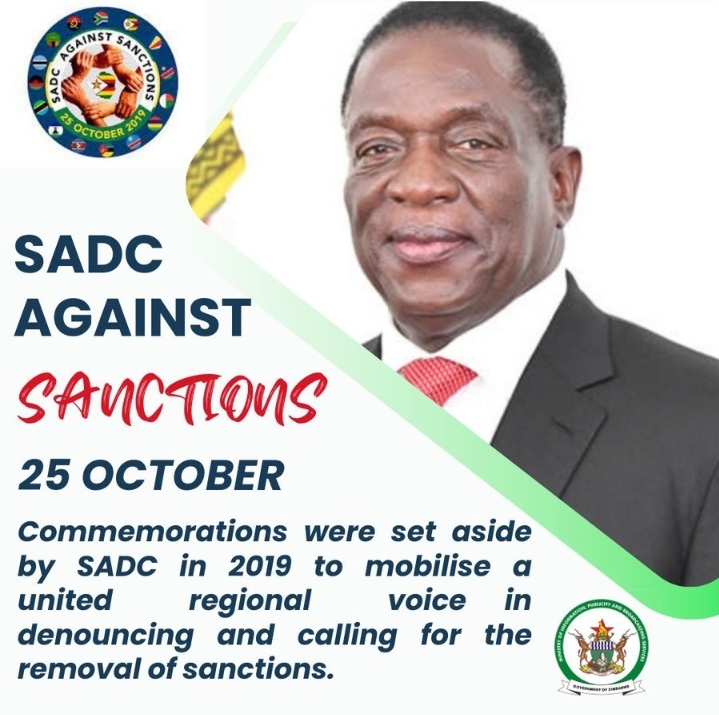
Zimbabwe commemorates five years of unwavering support from the Southern African Development Community (SADC) in its fight against crippling sanctions. This solidarity, initiated by the late Tanzanian President John Magufuli, underscores regional unity and determination to challenge unjust measures.

SADC’s campaign highlights the devastating impact of sanctions on Zimbabwe’s economy and regional integration. The organization’s advocacy has raised international awareness, mobilizing support from global leaders and organizations. This collective effort emphasizes the need for economic freedom and cooperation. 

Zimbabwe’s assumption of SADC chairmanship in August 2024 bolsters its leadership in regional policies and economic cooperation. President Emmerson Mnangagwa’s vision leverages this position to rally international backing, foster collaborations, and drive development. 

Zimbabwe’s determination shines through comprehensive development strategies and engagement initiatives. The country’s resilience, coupled with SADC’s unwavering support, demonstrates collective action’s transformative power. This partnership paves the way for economic growth, improved livelihoods, and regional prosperity.
Continue Reading
Click to comment

Leave a Reply

Your email address will not be published. Required fields are marked *

Current Affairs

Bulawayo Resident Dies from Acute Gastro-enteritis Amidst Contaminated Water Concerns

Published

on

Bulawayo Resident Dies from Acute Gastro-enteritis Amidst Contaminated Water Concerns

Bulawayo, Zimbabwe – A tragic incident in Bulawayo has highlighted critical public health concerns, with a resident succumbing to acute gastro-enteritis, commonly known as stomach flu. The death is reportedly linked to the consumption of contaminated borehole water in Pumula South, following disruptions to the municipal reticulated water supply.

The unfortunate fatality was documented in the latest health surveillance report issued by the Bulawayo City Council (BCC). Investigations detailed in the report indicate that the deceased did not seek timely medical intervention, leading to severe diarrhea and dehydration that ultimately proved fatal. Post-mortem examinations confirmed that the patient died from hypovolemic shock, a direct consequence of acute gastro-enteritis.

Further compounding the household’s distress, another individual within the same residence subsequently fell ill. Fortunately, this person recovered after receiving treatment at Mpilo Central Hospital, underscoring the severity of the water contamination.

Laboratory tests conducted on water samples from the affected borehole in Pumula South revealed significant contamination, specifically identifying the presence of non-faecal coliforms. This finding points to a serious breach in water safety standards, posing a substantial risk to public health.

Council health officials noted challenges in their investigation, as family members reportedly declined stool sampling and contact tracing efforts. This non-cooperation can impede comprehensive epidemiological assessments and the implementation of effective public health interventions.

The broader context of Bulawayo’s water infrastructure raises further alarms. Recent council water quality checks indicated that a staggering 62% of water points tested across the city failed one or more safety criteria, including instances of faecal contamination. This widespread issue has impacted numerous public facilities, including schools and clinics, in areas such as Nkulumane, Emganwini, and Luveve.

Adding to the crisis, the council’s most recent environmental health report also brought attention to persistent sewer overflows in Emganwini and numerous complaints regarding foul-smelling water in various residential zones. The report explicitly warned that the city’s aging sewer systems and the increasing pressure on existing water networks are significantly elevating public health risks.

In March alone, Bulawayo recorded 247 cases of diarrhea, with one fatality, as detailed in the report. Residents in the western suburbs, particularly affected by the worsening water situation, voiced their concerns, stating that they often have no alternative but to rely on potentially unsafe borehole water sources.

In response to these alarming developments, council health officials have issued an urgent advisory. Residents are strongly urged to boil or disinfect any water obtained from unverified sources. Furthermore, they emphasize the critical importance of seeking immediate medical attention for symptoms such as diarrhea, vomiting, and dehydration to prevent further tragic outcomes.

Continue Reading

Current Affairs

President Mnangagwa Appoints Justice Elizabeth Gwaunza as Chief Justice

Published

on

Harare, Zimbabwe – His Excellency, the President, Dr. Emmerson Mnangagwa, has officially appointed Justice Elizabeth Gwaunza as the new Chief Justice of Zimbabwe, effective May 15.

This pivotal appointment underscores the President’s commitment to strengthening the country’s legal framework and ensuring continuity in judicial leadership.

The announcement was made by Dr. Martin Rushwaya, the Chief Secretary to the President and Cabinet, who confirmed that the appointment was executed in strict adherence to Section 180 of the Constitution of Zimbabwe. This constitutional provision empowers the President to make such crucial judicial designations, reflecting the robust legal processes governing the nation.

Justice Gwaunza brings a wealth of experience and a distinguished career to her new role. She has served with exemplary dedication as the Deputy Chief Justice since March 29, 2018, a tenure marked by profound legal expertise and unwavering commitment to justice. Her extensive background in the judiciary positions her as a highly capable leader to steer the country’s highest court.

Further reinforcing the judiciary’s leadership, Dr. Rushwaya also announced the appointment of Justice Paddington Garwe as the new Deputy Chief Justice. Justice Garwe has been a respected figure on the Constitutional Court bench since May 20, 2021, where he has consistently demonstrated a deep understanding of constitutional law and its application. His elevation to Deputy Chief Justice is a testament to his legal acumen and contributions to the country’s jurisprudence.

These appointments are anticipated to further enhance the efficiency and integrity of Zimbabwe’s judicial system, ensuring that justice continues to be administered fairly and effectively for all citizens. The new leadership is expected to uphold the principles of the rule of law and contribute to the ongoing national development agenda.

Continue Reading

Current Affairs

SADC ministerial meeting on disaster risk management convenes in Masvingo

Published

on

Itai Mazire

The 6th Ordinary Session of the SADC Ministerial Meeting on Disaster Risk Management was officially opened yesterday at the Great Zimbabwe Hotel, showing a unified regional commitment to safeguarding lives, livelihoods and development gains against the backdrop of increasingly frequent and severe environmental shocks.

The meeting, which commenced with senior officials on Monday, saw ministers from across the Southern African Development Community (SADC) convene to bolster regional cooperation in disaster management.

Hon. Daniel Garwe, Minister of Local Government and Public Works, addressed his counterparts, appreciating the critical timing of the gathering.

He highlighted the recent devastating floods and cyclones that impacted Malawi, South Africa, Mozambique and Madagascar during the previous rainfall season.

“This meeting is convened at a critical moment for our region. The recent rainfall season has once again reminded us of the devastating power of nature,” said Hon. Garwe, framing these events as part of escalating patterns driven by climate variability and change.

Hon. Garwe lauded the SADC Humanitarian and Emergency Operations Centre (SHOC) for its swift deployment of Emergency Response Teams to affected nations.

He urged continuous strengthening of SHOC’s capacity to assist Member States in disaster preparedness, response and recovery.

He commended SADC Member States, partners and responders for their exemplary regional solidarity, noting the ongoing development of a SADC Prepositioning Strategy.

This strategy aims to enhance regional preparedness through the mobilisation and stockpiling of humanitarian relief resources for anticipatory action.

He further stressed the evolving nature of disasters, remarking,

“The disasters we face today are becoming more complex, more intense and more interconnected.

“Floods, droughts, cyclones and other hazards are no longer occasional shocks; they are recurring challenges that threaten our development trajectory.”

In light of this, Hon. Garwe stressed the imperative to integrate anticipatory approaches to shield communities from adverse weather impacts.

He encouraged Member States to prioritise the operationalisation of the SADC Disaster Risk Management Strategy, translating it into tangible outcomes.
Commendable progress has been made in fortifying disaster risk management systems, including the establishment of regional frameworks, early warning systems (EWS) and coordinated response mechanisms.

He called upon Member States to invest in data, technology and information sharing to enhance early warning for early action.

Identifying climate change as a primary driver of disaster risk in the region, Hon. Garwe advocated for the inclusion of climate adaptation and disaster risk reduction into national development plans.

“In that regard, infrastructure must be climate-proofed to withstand the vagaries of climate change; agriculture must also adapt, while urban planning must be alive to climate risk. In doing so, we will not only reduce vulnerability but also unlock opportunities for green growth and innovation.”

He concluded by asserting that resilience building originates at the local level, necessitating the empowerment of communities through community-based disaster risk management and inclusive approaches that involve women, youth, and persons with disabilities.

Member States were also encouraged to leverage technology to improve their predictive, preparatory, and responsive capabilities regarding disasters.

Hon. Velenkosini Fiki Hlabisa, Chairman of the Committee of Ministers Responsible for Disaster Risk Management, echoed these sentiments, highlighting that the meeting convened at a time when the region grapples with increasingly complex and interconnected disaster risks.

He pointed out that climate change, rapid urbanisation, environmental degradation and socio-economic vulnerabilities collectively exacerbate the frequency and intensity of disasters.

Hon. Hlabisa emphasised that the meeting provided a crucial opportunity for the region to reflect on progress, assess existing gaps and reinforce regional cooperation in disaster preparedness, early warning systems, response, recovery, and resilience building.

He implored Ministers Responsible for Disaster Risk Management to ensure the full integration of DRM into regional and national development planning and to recognise the importance of resilience, recovery and reconstruction efforts that not only restore what has been lost but also mitigate future risks.

Speaking on behalf of SADC Executive Secretary Mr Elias Magosi, SADC Deputy Executive Secretary for Regional Integration Ms Angele Makomo N’tumba asserted that preparedness must be a permanent function of government and regional cooperation.

She urged SADC to strengthen its internal mechanisms to reduce vulnerability to external shocks in humanitarian financing.

The meeting also saw the attendance of Hon. Ezra Chadzamira, Minister of State for Provincial Affairs and Devolution for Masvingo; Hon. Eng. B. Kabikira, Deputy Minister of Local Government and Public Works and various development partners.

Continue Reading

Trending