Current Affairs
Government Targets One Million New Homes By 2030

Itai Mazire
Government has unveiled a five-year plan to build another one million housing units between 2026 and 2030, even after delivering 1 million homes in the previous five years, because the nation’s housing deficit keeps shifting.
Speaking at the Second Africa Urban Forum in Nairobi, Kenya, Local Government and Public Works Minister, Hon. Daniel Garwe said that the country began its National Development Strategy (NDS1) with a deficit of approximately 1.5 million housing units.
The government successfully completed 1 million units in that first phase.
But the deficit, Hon. Garwe stressed, remains elusive.
“Faced with a deficit of approximately 1.5 million housing units at the onset of the strategy NDS1, 1 million housing units were achieved in the first 5 years. Cognisant of the fact that the deficit is a moving target, the second 5-year window, running from 2026 to 2030, is targeting another 1 million housing units,” said Hon Garwe
The announcement came during a constructive address under the forum’s theme: “Adequate Housing for All: Advancing Socio-economic and Environmental Transformation towards the realisation of Agenda 2063.”
Hon Garwe rejected the notion of housing as mere shelter.
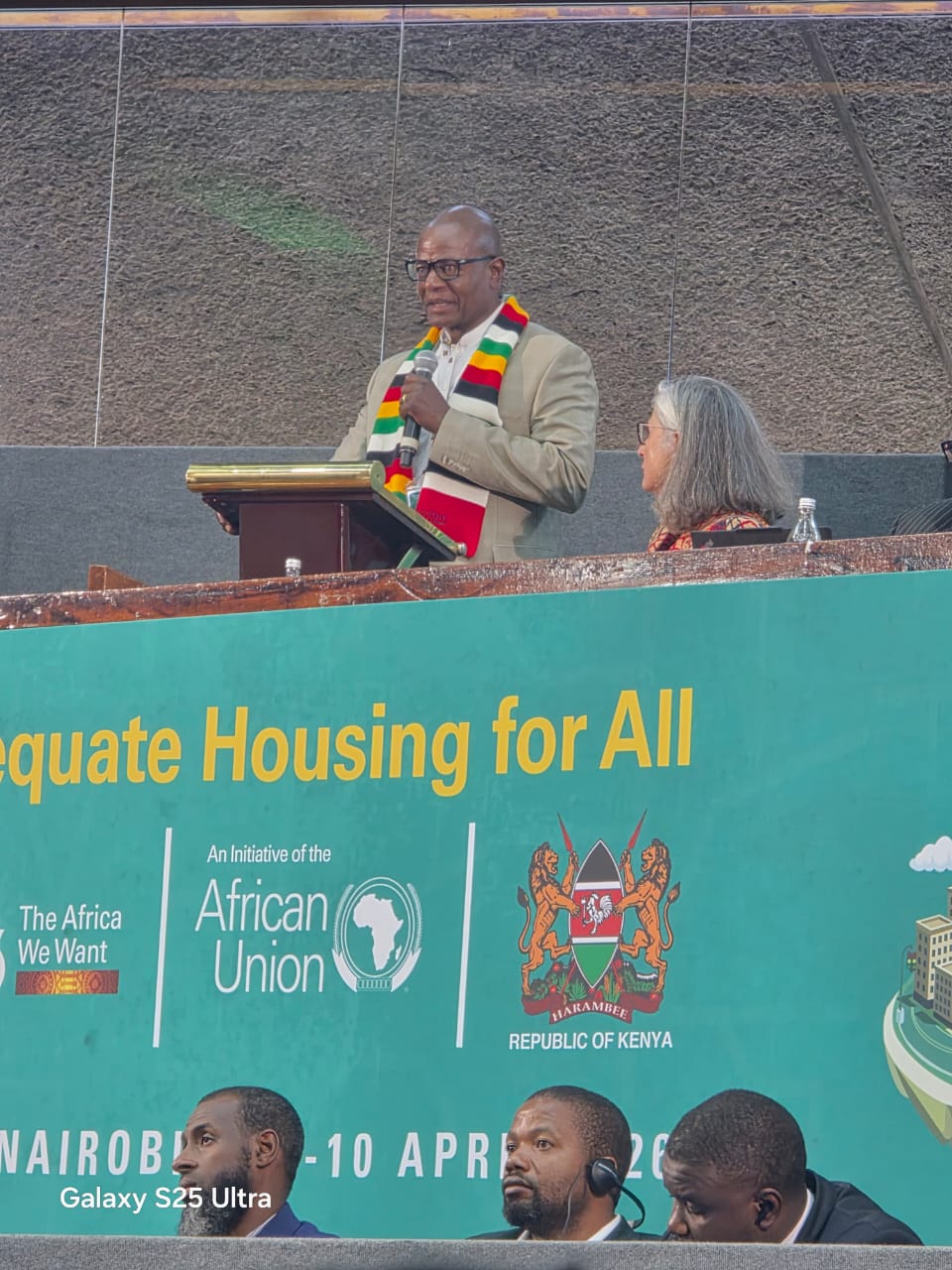

“We view housing as a fundamental human right and a vital element in our journey towards Vision 2030, of becoming a prosperous and empowered Upper-Middle-Income Society,” he told delegates, including ministers from across the continent.
To meet the new target, Zimbabwe is deploying radical measures. The government has mandated 40 percent of residential land be reserved strictly for flats, cluster housing, and mixed-use developments, a policy designed to curb urban sprawl and protect prime agricultural land.
At the same time, a Presidential Title Deeds Programme aims to issue 1.5 million title deeds, transforming informal settlements into legally recognised assets.
“The government has enunciated a policy that has mandated a 40 percent land-use for strictly residential flats developments and cluster housing and mixed residential land use,” he said.
On financing, the government has revitalised the National Housing Fund as a revolving facility and increased its shareholding in pan-African housing lender Shelter Afrique to 5 percent, a move to unlock long-term, low-cost capital.
He also signalled a sharp shift in philosophy.
“We are moving away from purely social expenditure toward making housing a ‘bankable economic sector,’ by engaging private players to partner with the State in commercial joint ventures and Public Private Partnerships (PPPs),” he said.
Hon Garwe said Climate resilience is also being written into the blueprint, with “Green Building” standards and smart technologies now mandatory for new settlements.
“The ‘Africa We Want’ cannot be built on the foundations of slums or exclusion. It must be built on inclusive, safe, and resilient cities,” he said
He closed with a blunt invitation to investors and member states alike.
“Zimbabwe is open for business, open for partnership, and determined to build a nation where every citizen lives in dignity, security and prosperity.”
Hon Garwe said Zimbabwe stands ready to share best practices on informal settlement transformation and innovative mortgage financing across the continent.