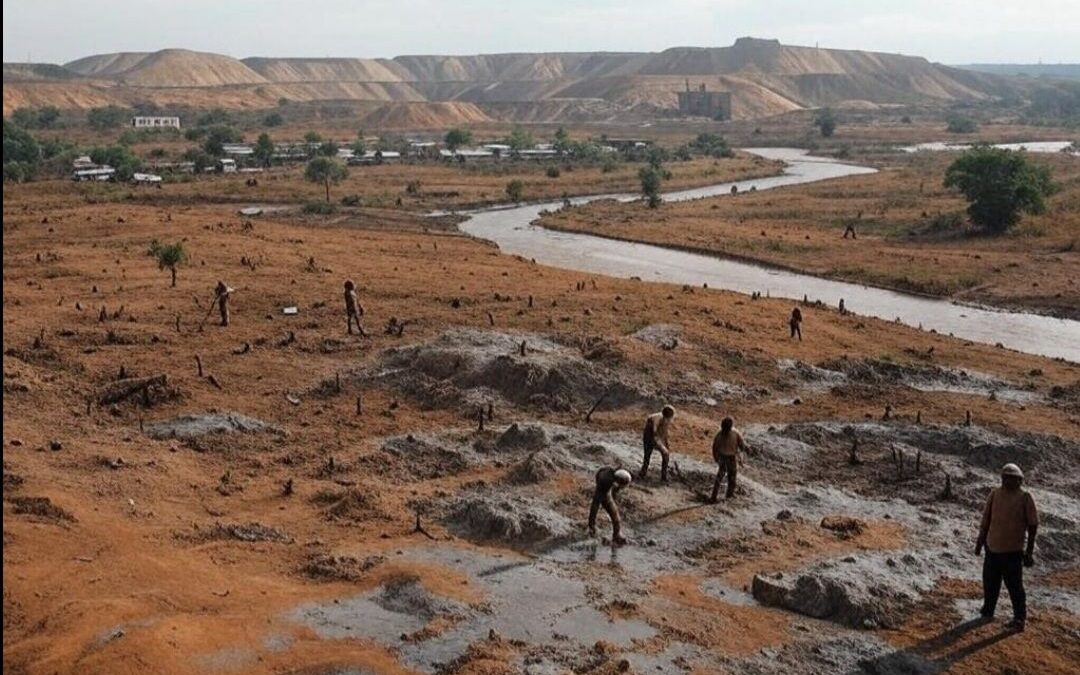
Rural communities in Matabeleland are increasingly at risk of losing access to agricultural land, homes and water sources as mining activities expand, a Nkayi-based lawyer has warned.
Richard Moyo Majwabu said existing laws gave the State control over underground mineral resources while offering communities limited protection over the land they occupy and the livelihoods dependent on it.
Speaking during a virtual discussion organised by the Nkayi Community Parliament, Majwabu said the issue was particularly important in rural districts such as Nkayi, where households rely heavily on farming, livestock production and natural resources.
He noted that most rural Zimbabweans did not hold full private freehold title to the land they occupied. Communal land is vested in the President, while A1 farmers generally operate under customary permits and A2 farmers hold leases issued by the State.
Majwabu said the absence of transferable title deeds restricted farmers’ ability to use land as collateral, attract investment and secure their property rights for future generations.
“The absence of transferable title deeds limits farmers’ ability to use their land as collateral, invest with confidence and secure inheritance,” he said.
He added that the Mines and Minerals Act vested mineral rights in the State, regardless of who owned or occupied the land’s surface.
“A landowner or communal land occupant has no automatic right to the minerals beneath their land,” Majwabu said.
While the arrangement ensures that minerals remain national assets, he warned that it could leave rural communities vulnerable when mining operations interfere with fields, grazing areas, wells and homesteads.
“Surface occupants can find their fields, wells and homesteads disrupted by miners with superior legal rights, often for compensation they see as inadequate,” he said.
Majwabu said mining was increasingly competing with agriculture for rural land because mineral extraction could generate foreign currency more quickly than most farming activities.
He warned that poorly managed mining could contribute to displacement, environmental degradation, social conflict and the movement of rural labour away from agriculture and into artisanal mining.
“Some rural households have shifted labour and youth away from farming into artisanal mining, chasing faster, if riskier, income—with knock-on effects for food security and school attendance,” he said.
However, Majwabu said mining and agriculture could coexist if supported by effective land-use planning and clear community-benefit arrangements.
He argued that responsible mining could create jobs, stimulate local businesses and help finance infrastructure development in rural areas.
“The honest message is that this is not a contest either sector needs to ‘win’ outright—the real policy failure is the absence of effective land-use planning and community-benefit mechanisms that would let both coexist,” he said.
Among his proposals was a legally enforceable requirement for prior consultation and free, prior and informed consent before prospecting or mining claims were registered on occupied communal or resettlement land.
He also called for minimum compensation standards and a publicly accessible register identifying holders of prospecting and mining rights.
Majwabu further raised concern about rural residents investing in homes and other structures on land without title deeds, saying such investments remained vulnerable and could not easily be used as collateral.
He urged communities to preserve all available documentation, including written land-allocation records, permits and other proof of occupation, to strengthen their position in potential disputes.
Former Tsholotsho legislator Maxwell Dube said rural communities needed to be formally recognised and involved in decisions concerning minerals found in their areas.
“Even the communities must be recognised by the Government,” Dube said, questioning whether residents were receiving a fair share of the mineral wealth extracted from their localities.
The discussion comes amid reports of a dispute in Bubi District, where villagers allege that miners from Mashonaland took control of a gold-mining site in Gududu Village 12 and forced local residents away.
Villager Bongani Ncube claimed the miners had taken over the area, filled in pits dug by community members and fenced off the site. He also alleged that an individual identifying himself as a soldier was called after he confronted the miners.
Ncube said armed police officers later visited his home, leaving him concerned about his safety.
Matabeleland North Provincial Affairs and Devolution Minister Richard Moyo said he had not yet been briefed on the reported dispute. He advised the villagers to report the matter to the police and the Ministry of Mines.
“These could be criminal people who, upon hearing about a gold rush, pounce on the area to start pegging and abusing the communities,” he said.
Majwabu said communities should demand meaningful participation before mining decisions were made, rather than waiting to seek compensation after their land and livelihoods had already been affected.
The debate highlights the need for Zimbabwe to balance mineral development with food security, environmental protection and the rights of rural communities whose land is targeted for mining.