African nations are bracing for a catastrophic economic blow and widespread displacement as a “super” El Niño event looms on the horizon, according to Anthony Nyong, the African Development Bank’s (AfDB) director for climate change and green growth.
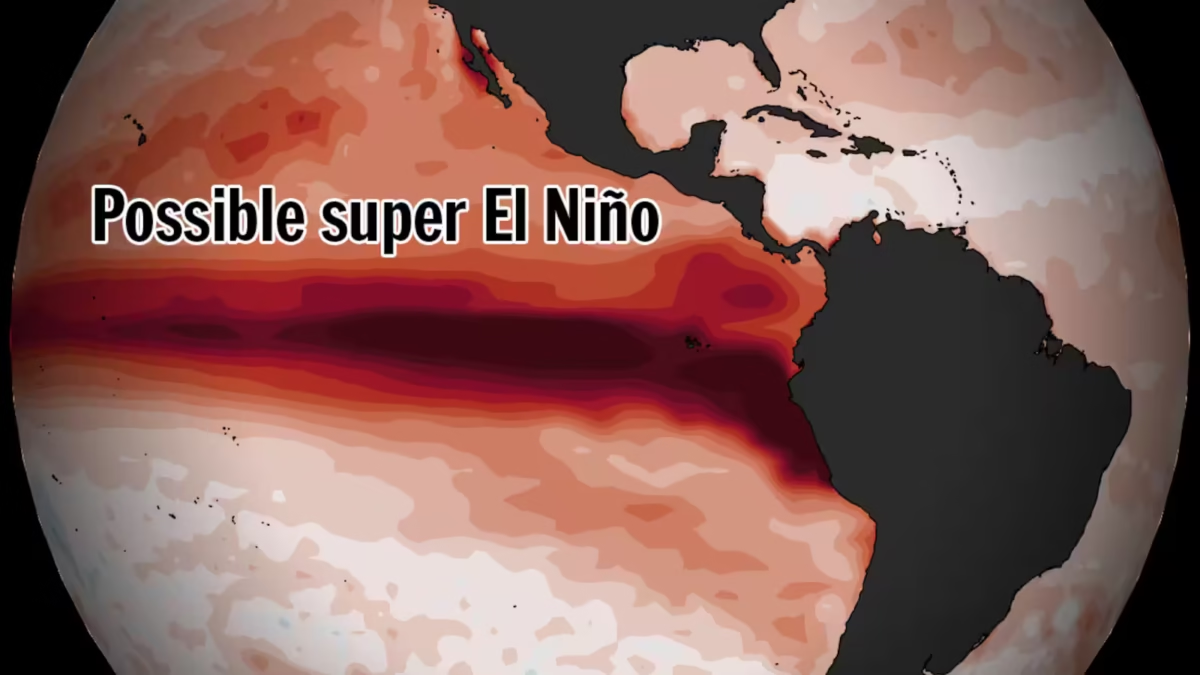
Meteorologists caution that if the current warming patterns in the Pacific Ocean persist, the impending El Niño could evolve into one of the most severe instances ever recorded. This phenomenon, which typically unleashes a devastating combination of extreme flooding, severe droughts, and violent storms across the African continent, poses an existential threat to food and water supplies.
Beyond the immediate humanitarian crisis, the financial stability of already vulnerable governments and their banking sectors is at severe risk. Should infrastructure be destroyed and recovery costs balloon, cash-strapped nations may find it nearly impossible to meet their loan obligations.
According to Nyong, the economic toll of this single weather event could be staggering. “Just this event is going to reduce heavily affected countries’ GDP by 1 percent to 2 percent on average, which is about $10 billion to $20 billion across the continent,” he stated in a recent interview.
These dire projections come despite the AfDB’s May forecasts, which had optimistically predicted a 4.2 percent economic growth rate for Africa this year, with an anticipated rise to 4.4 percent in 2027. Those projections were based on assumptions that geopolitical conflicts, such as the U.S.-Israeli war on Iran, would de-escalate. The emergence of a “Godzilla” El Niño has since upended those expectations.
Nyong’s warning marks the first time a major multilateral development bank has quantified the projected financial damage of the upcoming El Niño. While he declined to break down the figures by individual nation, he emphasized that the economic disruption would likely be a recurring burden rather than an isolated incident.
The continent is already reeling from the aftereffects of previous climate shocks. Many parts of the Sahel region have been locked in a state of persistent drought, and the catastrophic Cyclone Idai in 2019 demonstrated that Mozambique—and similar nations—could require years to rebuild after extreme weather events. Furthermore, the 2023–2024 El Niño cycle had already triggered massive crop failures, skyrocketing food prices, and unprecedented sea-level surges along Africa’s coastlines, following severe dry spells in the south and devastating floods in the east.
Nyong highlighted a devastating cycle he termed the “climate finance trap.” Because governments lack the reserves to absorb these shocks, they are often forced to cannibalize critical budgets for healthcare, education, and infrastructure just to manage the immediate fallout.
The agricultural sector is taking a massive hit. The AfDB estimates that African farmers are currently losing nearly $330 million in income this year, with the fishing industry also under severe threat from warming seas and violent storms. Fisheries productivity is projected to drop by 1 percent to 4 percent, and agricultural losses are already estimated at around $327 million.
“When these shocks happen, countries take two steps back,” Nyong observed, underscoring the urgent need to prevent vulnerable populations from sliding further into poverty.
In response to the looming crisis, the AfDB plans to intensify its efforts. A bank-wide assessment seminar is scheduled for September, where senior officials will evaluate how the impending weather disaster might affect both current and future investment portfolios. Nyong noted that the institution is prepared to restructure existing projects to help nations cope and is actively collaborating with them to access additional funding from multilateral sources like the Green Climate Fund. Other financial safety nets could include the Adaptation Fund, Climate Investment Funds, and emerging loss-and-damage financing structures.
The scale of the required financial intervention is immense. A recent October report from the United Nations projected that developing nations will require approximately $365 billion annually by 2035 to combat climate change, a stark contrast to the mere $26 billion provided in international public adaptation finance in 2023.
Given the anticipated intensity of this El Niño, Nyong believes Africa’s immediate financial needs have skyrocketed. “The (climate adaptation finance) need was already about $50 billion,” he noted, referring to the upcoming 12-month period. “But this adds another $30 billion to $50 billion to that,” bringing the total required funding to as much as $100 billion this year alone.
The humanitarian consequences are expected to be equally severe. The AfDB has flagged several nations—including Sudan, South Sudan, the Democratic Republic of Congo, Somalia, Mali, Burundi, and Nigeria—as being at exceptionally high risk.
“When this El Niño comes there is going to be mass migration,” Nyong warned, predicting that the cost of maize, a critical staple for millions, will likely double. “You are not going to stay put, you are going to move.” He cautioned that the resulting scarcity of resources and intense competition for arable land and water could further destabilize already fragile regions.
Ultimately, Nyong stressed that Africa must take proactive measures to fortify its resilience before the next disaster strikes—a core theme that will dominate the upcoming global climate summit in Turkey this November.
Summarizing the urgent need for preventive action, he offered a stark analogy: “It is cheaper to build a fence around a precipice than to pay for expensive ambulances to wait at the bottom for people to fall. So let’s build a fence.”