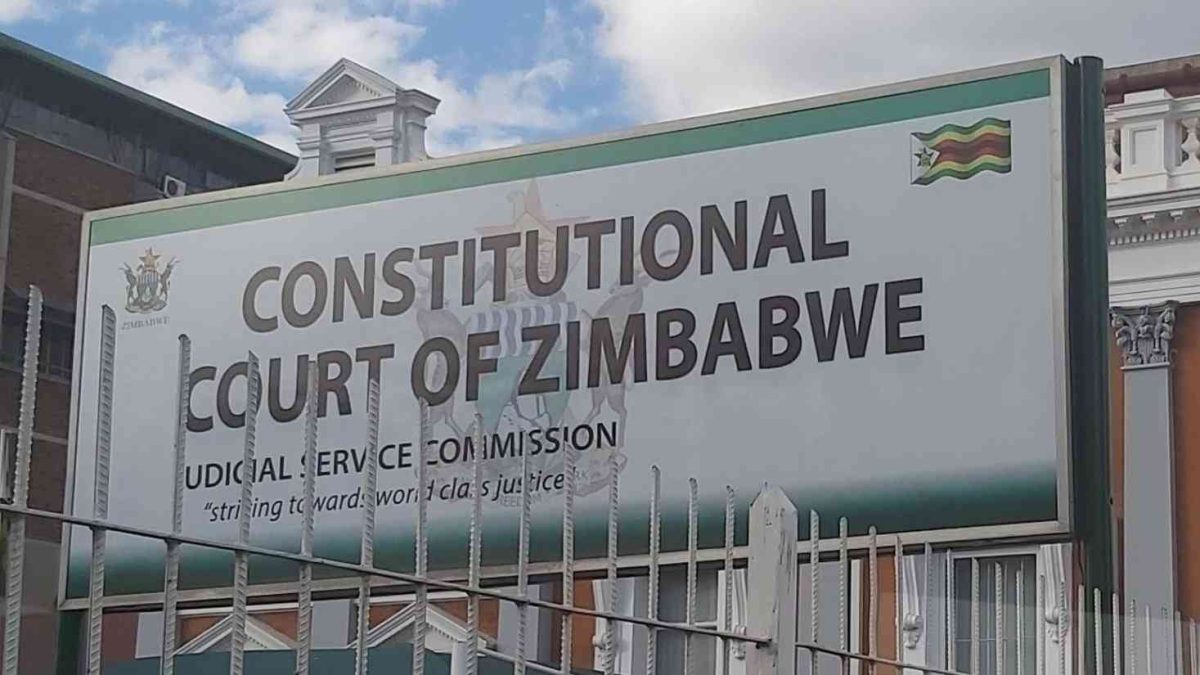
The Constitutional Court of Zimbabwe has once again sided against opponents of the Constitution Amendment (No. 3) Bill (CAB3), dismissing a challenge brought by former Binga North MP Prince Dubeko Sibanda. This decision effectively removes a significant legal hurdle, allowing the controversial legislation to proceed through Parliament.
In a unanimous judgment, Justice Bharat Patel, supported by Chief Justice Elizabeth Gwaunza, Deputy Chief Justice Paddington Garwe, Justices Rita Makarau, Susan Gowora, Ben Hlatshwayo, and Acting Constitutional Court judge Antonia Guvava, ruled that Sibanda’s application was premature. The court emphasized that the Bill is still undergoing the legislative process.
This ruling marks the second instance in recent months where the courts have refrained from intervening to halt CAB3 before its parliamentary completion. The proposed amendment includes provisions to extend the terms of office for the President and Parliament, alongside modifications to Zimbabwe’s electoral framework.
Sibanda had specifically contested clauses 4(b) and 9(b) of the Bill, arguing that they circumvented Section 328(7) of the Constitution. This section prohibits constitutional amendments that extend term limits from benefiting current office holders. He contended that Parliament had acted unconstitutionally by processing a Bill that explicitly stated it would operate “notwithstanding Section 328(7).”
However, the Constitutional Court chose not to deliberate on the merits of the challenge, instead focusing on whether the matter was ready for judicial review. Justice Patel highlighted that the Bill is still in progress and could be amended, rejected, or withdrawn during the legislative journey. Consequently, the court declined to engage in hypothetical constitutional disputes concerning a proposal whose final form remains uncertain.
Justice Patel stated in the judgment, “The final shape and form of the Bill remain presently unknown.”
The court underscored the importance of judicial restraint and the separation of powers, asserting that Parliament must be allowed to conduct its legislative duties without premature judicial interference. The judges also noted that constitutional safeguards would still be available later in the process. These include the President’s authority to return legislation to Parliament or seek an advisory opinion from the Constitutional Court if constitutional concerns arise after the Bill’s passage.
Crucially, the court did not issue a ruling on the constitutionality of the disputed provisions, leaving that question open for future determination if circumstances necessitate it. While the judgment did not endorse the contested clauses, its practical impact is substantial: the amendment process remains on track and continues its progression through Parliament.
This ruling follows another unsuccessful legal challenge by war veterans who had sought judicial intervention against the proposed constitutional changes. Collectively, these decisions indicate a reluctance by Zimbabwe’s courts to entertain attempts to halt the amendment process before Parliament fulfills its constitutional mandate.
The legal triumph for CAB3 comes shortly after the National Assembly overwhelmingly approved the Bill, with 216 legislators voting in favor. This comfortably surpassed the two-thirds majority threshold of 187 votes required for constitutional amendments. Forty-two legislators voted against the proposal. The outcome demonstrated significant support beyond Zanu-PF’s parliamentary ranks, with at least 35 opposition MPs joining ruling party lawmakers to secure this decisive victory.
The Bill is now slated to move to the Senate, where it must again secure a two-thirds majority to advance further. Political analysts anticipate a strong likelihood of its passage in the upper chamber, given Zanu-PF’s numerical dominance.
During parliamentary discussions, a proposal was raised for Parliament to have a consultative role in the appointment of the ten additional senators envisioned under CAB3.
If approved by the Senate, the Bill will be sent to President Emmerson Mnangagwa for his assent. Under Zimbabwe’s constitutional amendment procedures, a Bill must be passed by both the National Assembly and Senate before it can become law. With two court challenges dismissed and the National Assembly’s approval secured, CAB3 now enters what could be its final and most critical parliamentary stage.