Business and agriculture leaders meeting in Harare on Tuesday called for stronger links between farmers and formal markets, warning that production gains alone will not transform Zimbabwe’s agricultural economy without matching investment in market access, financing and technology.
📰 For this and more exclusive stories, read our weekly digital print edition.
Read E-PaperThe call came at the 2026 Zimbabwe Agricultural Show Breakfast Meeting, held at the Hyatt Regency Hotel under the theme “Powering Growth: Where Agriculture, Technology and Commerce Converge.” The event, jointly organised by the Zimbabwe National Chamber of Commerce (ZNCC) and the Zimbabwe Agricultural Society (ZAS) as part of the 116th Zimbabwe Agricultural Show, drew government officials, industry executives and development partners.
Delivering the keynote address on behalf of the Ministry of Agriculture, Mechanisation and Water Resources Development, Abraham Mashumba, representing the minister, said the ministry’s new Agriculture and Food Systems Transformation Strategy targets a 15.8 billion dollar agricultural economy, building on an earlier blueprint that ran through 2025. He said the strategy marks a shift from measuring success purely by tonnage to measuring the value created from what is produced.
Mashumba said Zimbabwe supplies more than 60 percent of the raw materials used by its industrial sector, but that much of the machinery, fertiliser and seed farmers depend on comes from other sectors, underlining the need for integration rather than treating agriculture in isolation. He identified technology adoption and stronger links to formal markets, which he said require consistency, quality, food safety and traceability, as central pillars of the strategy.
ZNCC chief executive Christopher Mugaga used his remarks to point to Africa’s trade relationship with China, citing continental exports to China valued at roughly 245 billion dollars through the Forum on China-Africa Cooperation, and said Zimbabwe needed to convert such trade opportunities into real returns for farmers. He said uncompetitive practices and monopolistic conduct in parts of the value chain were limiting the ability of farmers to benefit, and urged the platform to help address the barriers.
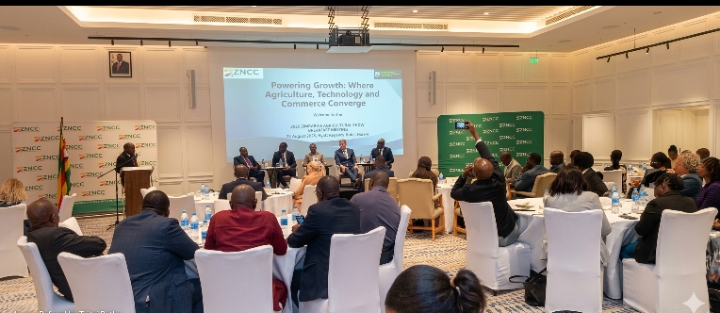
ZNCC president Josephine Takundwa said Zimbabwe’s agricultural sector suffers from a disconnect between production and the systems needed to convert it into income, describing a situation where production exists without procurement, demand exists without supply, and investment opportunities exist without investment. She said local content should be driven by competitiveness rather than obligation, and called on financial institutions, technology firms and development partners to each play a defined role in connecting producers to markets, adding that success should be measured in partnerships and contracts rather than discussion alone.
ZAS president Ngoni Kudenga outlined five practical outcomes he wants the sector to pursue: better market intelligence to guide production, stronger aggregation and coordination mechanisms for smallholder and commercial farmers, structured financing and risk management tools linked to offtake agreements, wider adoption of technology to cut costs and reduce post-harvest losses, and policy dialogue to remove constraints on domestic trade and exports. He said market barriers facing producers include limited information, inconsistent volumes and quality, weak aggregation, high logistics costs and unreliable financing, and stressed that smallholder farmers, women and young people must not be left out of any solution.
Louis Muhigirwa, deputy representative of the United Nations Food and Agriculture Organization, said market access remains central to building resilience in Zimbabwe’s agricultural sector, particularly as extreme weather events linked to climate change put growing pressure on producers. He called for smallholder farming to be treated as a viable commercial activity rather than a subsistence one, and reaffirmed the FAO’s commitment to working with government, the private sector and financial institutions on the sector’s transformation.
The breakfast meeting also featured a panel discussion titled “Connecting Agri-Producers to Markets: Overcoming Barriers Through Innovation and Policy,” moderated by Kudzanai Sharara, who also served as director of ceremonies. Panelists included Dayford Nhema of the Ministry of Industry and Commerce, Tatenda Marume of ZimTrade, Dustin Willcox of Food Lover’s Market and Moses Chihuri of Spar Zimbabwe. The session was followed by a plenary discussion before closing the breakfast meeting.