📲 Join our WhatsApp Channel for Breaking News!
Follow on WhatsAppGovernment has pledged to end mercury use in artisanal and small-scale gold mining (ASGM) across all eight mining provinces, with the Permanent Secretary for Mines and Mining Development, Dr Thomas Wushe has said.
📰 For this and more exclusive stories, read our weekly digital print edition.
Read E-PaperHe said the objective is for the project to reach every ASGM area in all eight mining provinces, so that no miner and no place is left behind as we make mercury history in Zimbabwe.
Addressing the planetGOLD Zimbabwe Project Annual Stakeholders Conference in Harare, Dr Wushe, whose remarks were delivered on his behalf by Shantel Mustaviao, Acting Deputy Director in the Metallurgy Department, reaffirmed Government’s commitment to mercury-free gold extraction, warning that the sector’s substantial contribution comes at a cost.
Artisanal and small-scale miners have contributed well over 50 per cent of Zimbabwe’s gold production and exports for the past several years.
“The heavy use of mercury in gold extraction does lasting harm to human health and the environment. Mercury does not stay where it is used. It travels across communities through air, water and the food chain,” said.Dr Wushe
He explained why Zimbabwe joined the Minamata Convention on Mercury.
“Article 7 of the Convention speaks directly to countries like ours, with significant ASGM sectors. It calls us to reduce and, where feasible, eliminate the use of mercury in gold extraction.”
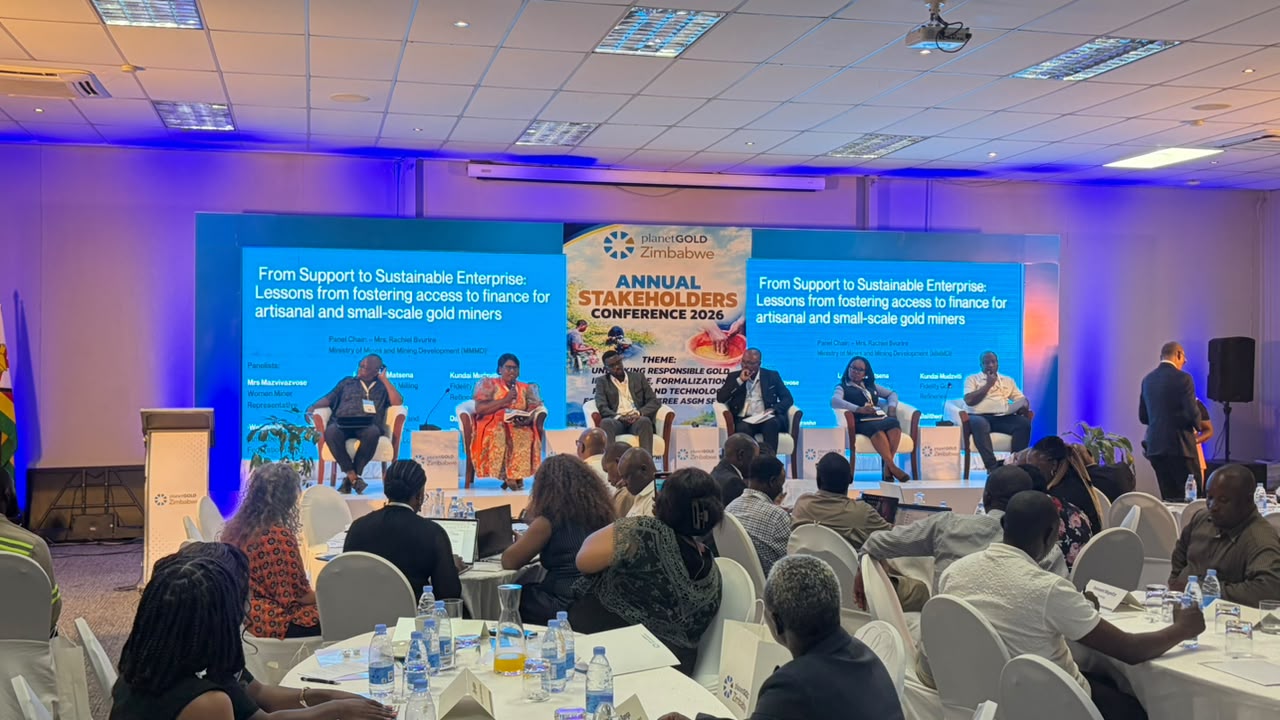
Launched two years ago, the planetGOLD Zimbabwe Project is supported by the United Nations Environment Programme (UNEP), funded by the Global Environment Facility (GEF) and executed by IMPACT, in collaboration with the Ministry of Mines and Mining Development and the Ministry of Environment, Climate and Wildlife.
The project advances the Ministry’s goal of sustainable mining under the National Development Strategy 2 (NDS2) and Vision 2030, and is anchored on four pillars: formalisation of ASGM; access to finance and markets; knowledge sharing; and adoption of mercury-free gold extraction technologies and methods. “Formalisation comes first because it makes the other three possible,” Dr Wushe said.
Reporting on progress, he said demonstration sites for mercury-free technology had been profiled and gold ores were being characterised, because different ore bodies need different processing methods and each site must be matched with the right technology.
Meetings and workshops have brought small-scale and large-scale miners together to find ways of working side by side, while finance workshops gave ASGM miners a platform to speak openly about funding challenges that will guide the solutions being developed. Roadshows and information, education and communication (IEC) materials have taken the message to mining communities so miners can learn about the effects of mercury and how to protect themselves while mercury-free alternatives are rolled out.
On the Ministry’s role, Dr Wushe said it continues to provide technical expertise to identify and promote technologies suited to the country’s diverse mining conditions and ore characteristics.
“Our focus is to ensure that the transition to mercury-free gold processing is guided by sound technical knowledge, practical experience and solutions that are appropriate for our miners,” he said.
Government called on mining stakeholders, development partners and mining communities to support the transition to responsible, mercury-free gold extraction.
The conference brought together the Permanent Secretary for Environment, Climate and Wildlife, Mr Simon Masanga, represented by Mr Matiza, Chief Bushu, Councillor Caswell Kagogoda, the Chief Government Engineer in the Ministry of Mines and Mining Development, Mr Munodawafa, the Director General of the Environmental Management Agency, Mr Chigona; the UNEP Representative, Ms Juliet Petlane, the IMPACT Programme Director, Ms Carmen Teichgraber; and representatives of government, development partners, industry, academia and the media.
Get instant news updates delivered straight to your WhatsApp.