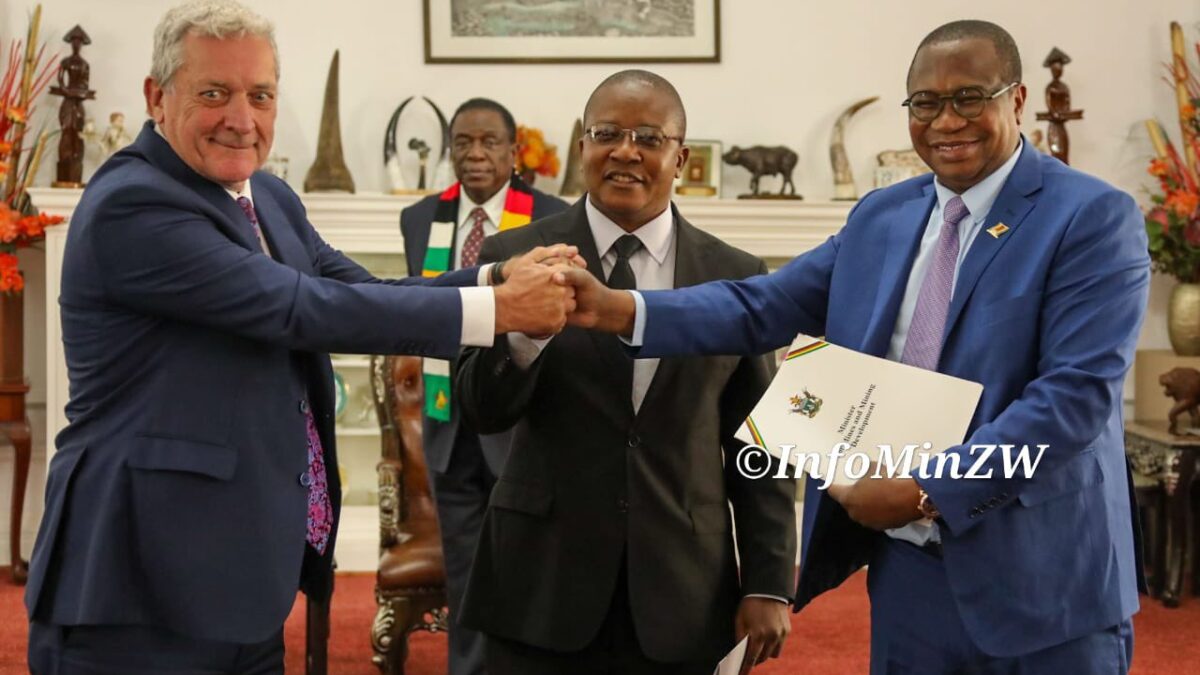
President Emmerson Mnangagwa on Monday witnessed the signing of a 25-year Special Mining Lease Agreement for the Karo Platinum Project, providing the regulatory and fiscal certainty required to advance one of Zimbabwe’s largest undeveloped platinum-group metals projects.
📰 For this and more exclusive stories, read our weekly digital print edition.
Read E-PaperThe agreement was signed at State House by Mines and Mining Development Minister Engineer Polite Kambamura and Finance, Economic Development and Investment Promotion Minister Professor Mthuli Ncube, together with representatives of Karo Platinum.
Karo Platinum is being developed by Karo Mining Holdings and is majority-controlled by South Africa-headquartered mining group Tharisa plc. The Government holds an interest in the project through Generation Minerals.
“The 25-year lease secures tenure and fiscal certainty over 23,903ha on the Great Dyke,” the Government said in its announcement.
It added that the agreement was “clearing the path to first production” at one of the world’s largest undeveloped platinum-group metals projects.
Government said the milestone demonstrated its commitment to mineral beneficiation and economic development.
“The milestone affirms Government’s commitment to value addition, investment and jobs under Vision 2030,” the statement said.
Funding hurdle addressed
The lease addresses one of the major uncertainties that had delayed the conclusion of financing for the project. Investors and lenders had been seeking predictable arrangements covering taxation, foreign-currency remittances, import duties and the servicing of dollar-denominated debt.
Tharisa chief executive Phoevos Pouroulis previously said substantive agreement had been reached with the Government on the project’s fiscal framework.
“Our financing team has made significant headway in structuring and negotiating facilities to achieve project completion,” Pouroulis said in May.
The signing could therefore allow Karo to finalise its outstanding funding package and accelerate construction. However, completion of the mine will still depend on finance being secured, infrastructure being delivered and commodity-market conditions remaining supportive.
Expected benefits for Zimbabwe
The Karo project could provide several economic benefits if it reaches commercial production.
Employment creation: Construction will create opportunities for engineers, miners, artisans, drivers, security personnel and other workers. Permanent jobs will also be created when mining and processing operations begin. The wider benefit will depend on how many positions go to Zimbabweans, particularly people from surrounding communities.
Increased export earnings: Platinum-group metals are major foreign-currency earners. New production from Karo could broaden Zimbabwe’s export base and strengthen a platinum industry currently dominated by Zimplats, Mimosa and Unki.
Government revenue: The project could generate corporate taxes, mining royalties, payroll taxes, licence fees and dividends from the State’s shareholding. This revenue could support public infrastructure and essential services, provided the fiscal terms offer a fair return to the country.
Local business opportunities: Zimbabwean companies could benefit from contracts to supply construction materials, transport, food, protective clothing, engineering services and equipment maintenance. Strong local-procurement requirements would help retain more of the investment within the domestic economy.
Infrastructure development: Mining projects of this scale require reliable roads, electricity, water and communication systems. Communities and other businesses could benefit if this infrastructure is designed for shared use rather than serving the mine exclusively.
Value addition: Local concentration, smelting and refining could allow Zimbabwe to earn more from its minerals than it would by exporting unprocessed ore. The extent of the benefit will depend on the processing commitments contained in the agreement and whether they are implemented.
Skills and technology transfer: A modern mechanised mine could provide apprenticeships, technical training and exposure to advanced mining and processing technology. Partnerships with universities, polytechnics and vocational colleges could deepen these benefits.
Project moving towards production
Karo is planned as a mechanised open-pit operation processing approximately 2.5 million tonnes of ore annually. It is expected to produce platinum, palladium, rhodium, ruthenium, iridium and gold.
Phase One capital expenditure has been estimated at approximately US$391 million. Exploration, earthworks and mine planning have advanced, while mining contractor mobilisation and open-pit waste stripping are underway.
Karo Mining says first ore is expected to enter the processing plant about 15 months after financial close. Recent projections have placed initial processing in the second half of 2027, but this remains subject to financing, construction and commissioning.
Public accountability required
Despite its potential, the project’s success should not be measured only by investment figures or production volumes.
Government and the investor will be expected to disclose the project’s employment targets, local-procurement commitments, community-development programmes and environmental safeguards. Transparency around tax concessions and other incentives will also be necessary to demonstrate that Zimbabwe is receiving a fair share of the mineral value.
Communities surrounding the concession will expect fair compensation where land or livelihoods are affected, protection of water sources and meaningful participation in decisions that influence their future.
The 25-year lease is therefore an important step towards production, but the real test will be whether Karo delivers sustainable jobs, export earnings, public revenue, local processing and lasting benefits for mining communities.