Connect with us

Current Affairs

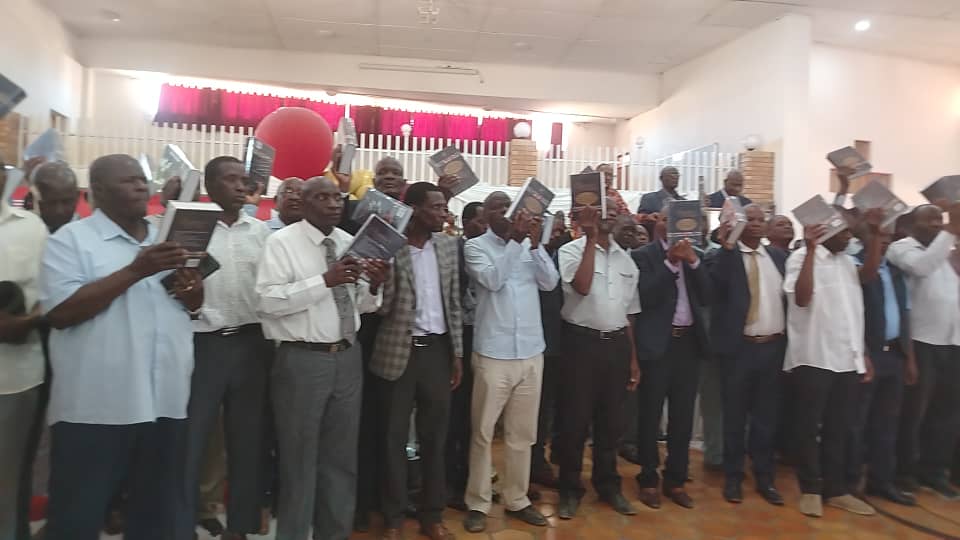
Agape Mission donates 12000 bibles

Published

on

By Sam Mupedziswa 
 

Minister of State for Provincial Affairs  and Devolution Honorable (Hon), Judith Ncube, this Saturday officiated an event of the distribution Study bibles to church leaders and Pastors from around Zimbabwe at Agape Mission in Nketa 7.

She was accompanied  by the Deputy Chief Secretary of Social Service, Reverend Paul Damasane, Nketa Constituency Member of Parliament Honorable (Hon.) A. T. Mavunga, ZANU-PF Central Committee members, Cde C. Ndlovu and Cde S. Jele. 

Church Bishops, pastors from different denominations, representatives of Jimmy Swaggart Ministries international, ZRP and  ZPCS were amongst the guest present. 

Minister of State, J. Ncube said, “she was informed that the donation of these study Bibles was donated by Mr Jimmy Swaggart, and the bibles were very critical, as they are an important part for teaching and leading the churches.” 

She further explained on how important the pastors are in moulding the community. The minister emphasized that, “religious leaders have power to raise aweness and influence attitudes, behaviors and practices in line with faith based teachings.” 

She added that even during this difficult time in the nation, as we are fighting against drug and substance abuse we look forward to seeing churches taking a lead role in fighting the menace, and compliment the government’s efforts. 

Cde Judith Ncube said,  “she wanted to encourage Pastors to come up with initiatives and various programs that will provide guidance and support young people. Helping them develop a sense of purpose, direction, and meaning, hence reducing drug and substance use.” 

The Minister of State for Provincial Affairs  and Devolution Honorable, Judith Ncube, emphasized that leaders can provide counseling and support services to young people struggling with addiction through awareness campaigns, workshop, congresses and meetings among other activities to promote drug and substance abuse awareness. 

The Minister of State urged churches to increase their capacity by working towards building partnership and collaborations with other organisations and stakeholders. Recently, she witnessed the launch of the Police Church Partnership, a good initiative that will help combat robberies and violent attacks on churches, and reduce crime in Bulawayo Metropolitan Province.

The minister of State further appreciated the Jimmy Swaggart Ministries for the donation of 12000 bibles. She added that the donation will go a long way in impacting the communities positively. 

The Minister was very glad that the police and the prison services have also benefited from this important donation of study bibles. She further prayed for the Lord’s blessings as the bibles will be used to preach and correct us.

Continue Reading
Click to comment

Leave a Reply

Your email address will not be published. Required fields are marked *

Current Affairs

Churches Throw Weight Behind CAB3, Urge Parliament to Pass Bill

Published

on

The Zimbabwe Indigenous Interdenominational Council of Churches (ZIICC), representing a broad coalition of Apostolic, Pentecostal, Evangelical and indigenous Christian denominations, has thrown its full support behind the Constitution of Zimbabwe (Amendment No. 3) Bill, 2026, describing the proposed changes as necessary for national stability, development continuity and governance reform.

In a detailed submission presented to Parliament on Friday, the church body said the proposed constitutional amendments were lawful, democratic and aligned with Zimbabwe’s long-term development aspirations under Vision 2030.

The submission, signed by ZIICC patron Bishop Dr Nehemiah Mutendi and chairman Rev Dr Andrew Wutawunashe, argued that Parliament has the constitutional authority to amend the Constitution and should be allowed to deliberate on the Bill without interference from external groups.

“We call upon Parliament to pass this Bill in the national interest,” the churches said in the submission.

The churches said Zimbabwe’s elected representatives derive their legislative authority directly from the people and are constitutionally mandated to amend the Constitution where necessary.

“Parliament’s exercise of that mandate is not and cannot be a threat to democracy it is democracy itself,” the submission stated.

ZIICC said public consultations conducted by Parliament across the country had already fulfilled constitutional requirements for citizen participation, adding that no organisation or civic grouping had the power to veto Parliament’s legislative role.

The church organisation, which says it represents more than 8.7 million Zimbabweans, also backed proposals in the Bill extending presidential and parliamentary terms from five to seven years.

According to ZIICC, the longer governance cycle would provide government with enough time to implement major developmental programmes such as Vision 2030 and the National Development Strategy 1 (NDS1), both of which it said had previously been disrupted by political instability and the COVID-19 pandemic.

The churches argued that Zimbabwe required policy continuity and stability to fully implement national projects and recover from external shocks.

“Vision 2030 is not a slogan to our congregants. It is a promise that must be kept,” the submission read.

ZIICC further linked the proposed seven-year term to biblical teachings on restoration and completion, saying the concept resonated with Christian principles of renewal and national rebuilding.

The churches also defended proposals to reform Zimbabwe’s electoral system, including the introduction of a parliamentary model for electing the President.

They argued that direct presidential elections had historically heightened political tensions and divided communities.

“Our communities have paid the price of electoral toxicity with their peace, their livelihoods, and their social cohesion,” the churches said.

ZIICC said electing the President through Parliament would reduce political conflict while preserving democratic accountability through elected representatives.

The churches additionally welcomed proposals to establish a dedicated Zimbabwe Electoral Delimitation Commission, saying the move would improve transparency and professionalism in constituency boundary delimitation.

On traditional leadership reforms, the church body endorsed the removal of constitutional restrictions limiting the political participation of chiefs and traditional leaders.

ZIICC said traditional leaders were custodians of community governance and should enjoy the same constitutional freedoms as other citizens.

“A traditional leader is a Zimbabwean citizen,” the submission stated, adding that chiefs play a critical role in maintaining peace, resolving disputes and supporting development at grassroots level.

The churches also supported provisions repealing the National Peace and Reconciliation Commission’s constitutional status, noting that the commission’s original constitutional mandate had already expired in 2023.

ZIICC said reconciliation should not be confined to a single commission but should instead become a broader national responsibility involving churches, traditional leaders and communities.

The organisation pledged to intensify reconciliation and healing programmes across the country in partnership with government and community structures.

In a cover letter accompanying the submission, Rev Dr Wutawunashe said the churches believed the Bill advanced “the constitutional order of Zimbabwe in a manner consistent with the values and aspirations of our people.”

The submission comes as debate around Constitutional Amendment Bill No. 3 continues to intensify, with supporters arguing the reforms will enhance governance efficiency and policy continuity, while critics have raised concerns over some of the proposed changes.

Continue Reading

Current Affairs

Local Government cracks down on ‘Fundraising’ workshops for Councils

Published

on

Itai Mazire

The Ministry of Local Government and Public Works has issued a stern directive to local authorities, urging them to cease participation in non-essential workshops and conferences perceived as mere fundraising ventures by external entities.

The move, outlined in a memorandum signed by Permanent Secretary Dr. John Basera on 14 May 2026, shows a critical shift towards prioritizing efficient service delivery amidst ongoing financial challenges.

The memorandum highlights a growing concern within the ministry regarding the proliferation of such events.

“It has been noted with concern that some institutions and entities are organising workshops and conferences targeting local authorities primarily for their fundraising purposes,” said Dr Basera.

This directive comes as local authorities grapple with

depressed revenue collection.

The Ministry emphasizes the need to re-direct resources towards core functions.

“Considering the current challenges facing local authorities, particularly depressed revenue collection and the need to prioritize efficient service delivery, it is imperative that available resources be directed towards operational and service delivery-related activities,” he said.

Local authorities are now advised to significantly reduce their involvement in events that do not directly contribute to improving public services.

The memorandum explicitly warns against arrangements that offer little to no tangible benefit.

“Accordingly, local authorities should not support or tolerate arrangements by third-party entities requiring the purchase of tables, payment of conference fees, accommodation costs and related expenditures which offer limited or no tangible value to service delivery outcomes.”

This new position is effective immediately and will remain in force until further notice, signaling a resolute effort by the Ministry to streamline operations and ensure accountability in resource allocation within local governance.

Continue Reading

Current Affairs

Malaba Urges Proper Governance in Farewell Address

Published

on

Retired Chief Justice Luke Malaba called for governance that serves all citizens and praised inter-branch cooperation as he delivered the vote of thanks at his retirement ceremony.

Speaking at a special sitting of the Constitutional Court, Malaba said the rule of law requires leaders to govern properly and create conditions for others to thrive.

Malaba said he leaves a vision of a Zimbabwe that all citizens can be proud to belong to, built on revolution, reform and adding value to people’s lives. He said he was proud to have lived and worked in government until his retirement

“Let us have a vision of a Zimbabwe where we can all be proud to belong. The vision of a revolution, the vision of reform, the vision of adding value to the lives of the people,” Malaba said.

He noted there is no rulebook defining what a Chief Justice should do, saying it falls to the person in office to create and innovate. Malaba said creation is only possible when those in power allow it and respect the judiciary’s role.

“There are no rules, there is no definition of what a Chief Justice should do. It is that person who is in an office of a Chief Justice who must create,” he said.

Malaba credited the executive and legislative arms for allowing the judiciary to operate independently. He said the progress was not his achievement alone but the result of many in government.

“The three arms of government have worked marvelously allowing the judiciary to pursue independently what is best for the country. It is a journey by many people in government,” he said.

Continue Reading

Trending