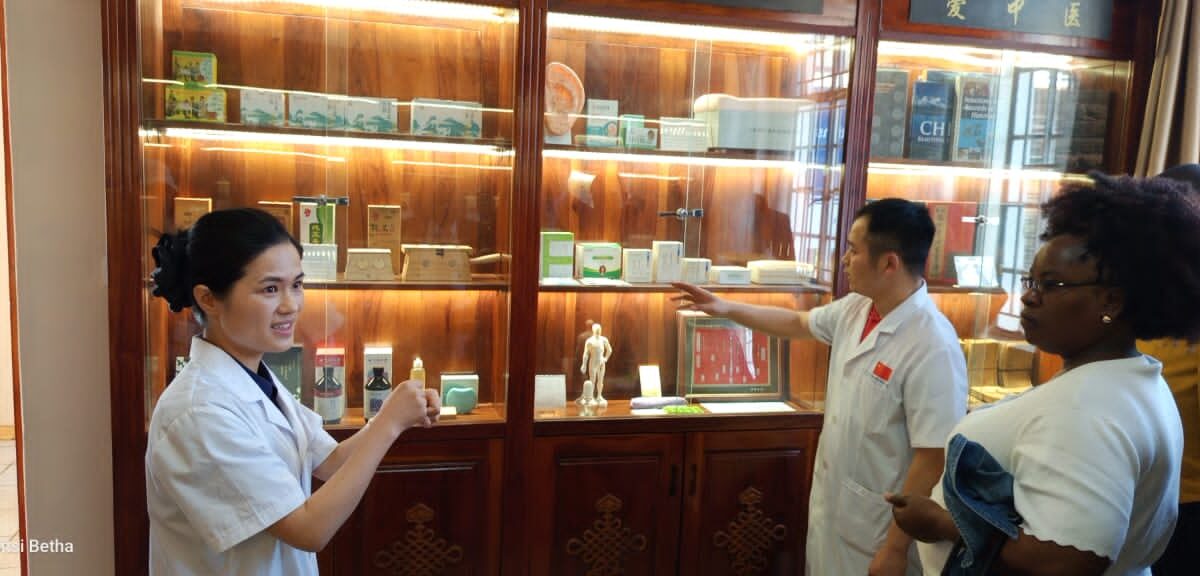
The Confucius Institute at the University of Zimbabwe, in partnership with the China Medical Team to Zimbabwe, hosted a cultural exchange and publicity event at the China-Zimbabwe Traditional Chinese Medicine Centre at Parirenyatwa Group of Hospitals yesterday.
📰 For this and more exclusive stories, read our daily digital print edition.
Read E-PaperHigh school principals and persons-in-charge from Chinese language teaching sites across the country attended an on-site visit, themed lectures on traditional Chinese medicine culture, and discussions on China-Africa cultural cooperation. Guests also received free acupuncture treatment during the tour.
The Chinese medical practitioners said the event formed part of efforts to deepen China-Africa people-to-people ties while popularising traditional Chinese medicine locally.
The event came as China deployed ten additional doctors to Zimbabwe to bolster free healthcare services under the medical cooperation programme.
Dr Peng Jie, of the China Medical Team, said the centre has treated more than 18,000 local patients since it opened and has trained over 300 Zimbabwean practitioners through in-person and online courses.
“Since the centre was founded, we have attended to over 18,000 local patients. We are also teaching local doctors, over 300 including those on the online course,” Peng said.
Dr Xue Lixia said importation restrictions currently limit the centre to non-invasive therapies rather than dispensing herbal medicine, though research is underway to change that.
“Nowadays we just offer acupuncture, cupping and massage, and herbal consultation, because the herbs are hard to bring into Zimbabwe due to import and export policy. We are building a laboratory to find whether local herbs can be used, guided by our TCM theory, to treat people here. There is no limitation,” Xue said.
She added that the centre intends to keep costs minimal even as it considers introducing modest fees to cover running expenses such as electricity and water.
“It is not our aim to charge our patients. Acupuncture at a private clinic can cost 100 to 200 dollars here, but we may only take 10. Even if we charge, it will just be the running fee of the clinic,” Xue said.
Xue added that the centre treats patients of all ages, from babies to the elderly, and has already begun extending services beyond Harare through outreach programmes, including a recent two-day free clinic in Bikita.
Charlotte Muziri, an administrative assistant at the centre, said her role involves bridging communication between patients and the Chinese doctors to ensure smooth service delivery.
“I help mostly with the administration between the patients and the doctors, so that it’s a seamless service provision for our local community,” Muziri said.
She said the centre’s reputation has spread mainly through word of mouth, with patients referring friends and relatives after positive results, and that treatment commonly addresses back pain, leg pain, chest pain, migraines and lifestyle management for high blood pressure, among other conditions.
Muziri, a former Miss International Zimbabwe titleholder and top model now pursuing a Master’s degree in Public Health, said her own introduction to the centre came through her father, who receives acupuncture treatment there.
Billed as the first official TCM centre and the largest of its kind in Southern Africa, the facility is jointly run by the China Medical Team to Zimbabwe and the Confucius Institute at the University of Zimbabwe.