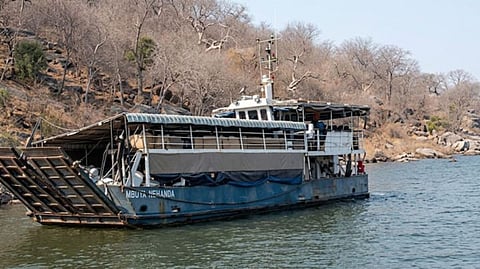
Two residents from the Kariba area have taken the government to the High Court, seeking an order compelling authorities to provide safe, reliable and adequate ferry services on Lake Kariba following the August disaster that claimed 97 lives.
📰 For this and more exclusive stories, read our weekly digital print edition.
Read E-PaperFisherman Tonderai Ndevani (39), from Batonga, and Chilumbo Mudenda, from Chief Sinakatenge’s area in Binga, filed an urgent application at the High Court sitting in Chinhoyi.
The applicants are challenging the government’s measures following the sinking of the Rural Infrastructure Development Agency (RIDA)-operated Mbuya Nehanda ferry, arguing that the current replacement arrangement does not adequately serve communities dependent on the lake crossing.
They are seeking an order compelling the Minister of Transport and Infrastructural Development, RIDA and the Minister of Local Government and Public Works to provide sufficient ferries that are safe, affordable and compliant with relevant laws.
The residents are also asking the court to order the authorities to submit monthly reports detailing progress towards procuring or providing replacement vessels.
The legal action follows the August 11, 2026 capsizing of the Mbuya Nehanda on Lake Kariba, which claimed 97 lives.
A RIDA district official, Ignatius Chiome, was later remanded in connection with a culpable homicide charge arising from the disaster. The State has alleged that administrative shortcomings, overloading and violations of safety procedures contributed to the accident.
Following the tragedy, the government announced that a privately owned ferry had been certified to resume water transport services.
Transport and Infrastructural Development Minister Felix Mhona said the vessel had undergone the necessary inspections, while two more boats were also being procured.
The privately operated MV Silverstone was later introduced to carry passengers and cargo along the Kariba-Chalala route.
The service was intended to reconnect fishing communities that had been cut off from their regular ferry connection after the Mbuya Nehanda disaster.
However, the applicants contend that the current arrangement remains insufficient.
In his court papers, Ndevani said travelling by road to Mola was beyond the reach of many residents, costing between US$40 and US$45.
He argued that the ferry had offered communities a faster and considerably cheaper alternative.
The applicants maintain that the ferry route is an essential transport link for communities in rural Kariba, Binga and Kariba town.
According to the application, residents depend on the service to access markets, healthcare facilities, schools and other essential services.
The residents are relying on constitutional provisions protecting freedom of movement and the right to human dignity.
They want the High Court to declare that the failure to provide adequate ferry services infringes on these rights and to order the responsible authorities to take corrective measures.
The case comes as authorities continue to address the aftermath of the Mbuya Nehanda disaster, including concerns surrounding water transport safety and accountability.
Government measures have included engaging private operators, while officials have indicated that additional vessels are being procured.
The latest application puts the adequacy of those measures before the High Court.
The respondents will have an opportunity to respond to the allegations and relief being sought. The court is yet to determine the application.